

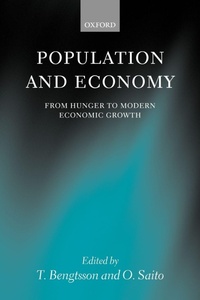
Population and Economy
From Hunger to Modern Economic Growth
Published on 3. April 2003
Book
Paperback/Softback
512 pages
978-0-19-926184-0 (ISBN)
Description
Malthus's Essay on the Principle of Population has for the past two centuries been a constant source of inspiration and debate for scholars working on relationships between population and economy in a historical perspective. This book sets a new standard in this active and influential field of research. The contributors go beyond the conventional European and North American geographical boundaries, bringing out new empirical findings and developing new arguments.
The volume is divided into three parts. The first part takes up classical issues -- the 'positive' and the 'preventive' checks and their determinants -- raised by Malthus himself, and examines the issues against fresh evidence from Europe, America, and Asia. These issues are also themes of the second part, which is devoted to short-term fluctuations in mortality and fertility in relation to prices, wages, and other economic indicators. The final set of chapters is a coherent collection of technically sophisticated articles from an on-going international joint project concerned with how households respond to economic stress in different economic, social, and cultural settings, in traditional China, Japan, Sweden, Belgium, and Italy. With a brief, but well-organized introduction, this collection of scholarly essays offers both demographers and economic historians a wealth of exciting findings and stimulating insights.
The volume is divided into three parts. The first part takes up classical issues -- the 'positive' and the 'preventive' checks and their determinants -- raised by Malthus himself, and examines the issues against fresh evidence from Europe, America, and Asia. These issues are also themes of the second part, which is devoted to short-term fluctuations in mortality and fertility in relation to prices, wages, and other economic indicators. The final set of chapters is a coherent collection of technically sophisticated articles from an on-going international joint project concerned with how households respond to economic stress in different economic, social, and cultural settings, in traditional China, Japan, Sweden, Belgium, and Italy. With a brief, but well-organized introduction, this collection of scholarly essays offers both demographers and economic historians a wealth of exciting findings and stimulating insights.
More details
Language
English
Place of publication
Oxford
United Kingdom
Target group
Professional and scholarly
Illustrations
numerous figures and tables
Dimensions
Height: 234 mm
Width: 156 mm
Thickness: 27 mm
Weight
769 gr
ISBN-13
978-0-19-926184-0 (9780199261840)
Copyright in bibliographic data and cover images is held by Nielsen Book Services Limited or by the publishers or by their respective licensors: all rights reserved.
Schweitzer Classification
Other editions
Additional editions
Book
08/2000
Oxford University Press
€111.20
Shipment within 15-20 days
Persons
Tommy Bengtsson, Professor in Economic History at Lund University and presently Professor in Demography at Odense University, has been working mainly on the complex relationship between population and economy, past and present.
Osamu Saito, a Professor in the Institute of Economic Research, Hitotsubashi University, Tokyo, has been working in both economic history and historical demography.
Osamu Saito, a Professor in the Institute of Economic Research, Hitotsubashi University, Tokyo, has been working in both economic history and historical demography.
Content
Introduction ; 1. What Determined the Onset of Modern Progress in the Standard of Living ; 2. Short-run and Secular Demographic Response to Fluctuations in the Standard of Living in England, 1540-1834 ; 3. Population, Poverty, and Subsistence in China, 1700-2000 ; 4. Population Growth and Population Regulation in Nineteenth Century Rural Scotland ; 5. Infant Mortality, Child Neglect, and Child Abandonment in European History: A Comparative Analysis ; 6. Malthus and North America: Was the United States Subject to Economic-Demographic Crises? ; 7. Malthus Revisited: Exploring Medium-Range Interactions between Economic and Demographic Forces in Historic Europe ; 8. Malthus in Latin America: Demographic Responses during the Nineteenth and Twentieth Centuries ; 9. Structural Factors Affecting the Short-term Positive Check in Croatia, Slavonia, and Srem in the Eighteenth and Nineteenth Centuries ; 10. Determinants of Mortality Variability in Historical Populations and its Behavioural and Aggregate Consequences ; 11. Inequality in Death: Effects of the Agrarian Revolution in Southern Sweden, 1765-1865 ; 12. Mortality and Economic Stress: Individual and Household Responses in a Nineteenth-Century Belgian Village ; 13. Price Fluctuations, Family Structure, and Mortality in Two Rural Chinese Populations: Household Responses to Economic Stress in Eighteenth- and Nineteenth-Century Liaoning ; 14. Mortality Responses to Short-term Economic Stress and Household Context in Early Modern Japan: Evidence from Two Northeastern Villages ; 15. Infant Mortality in Nineteenth-Century Italy: Interactions between Ecology and Society