

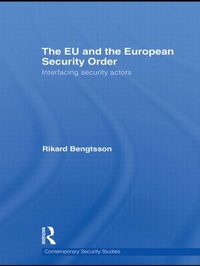
The EU and the European Security Order
Interfacing Security Actors
1st Edition
Published on 14. July 2009
Book
Hardback
186 pages
978-0-415-49723-7 (ISBN)
Description
This book attempts to conceptualise EU action in the field of regional security.
Drawing on constructivist theory, the framework of the book focuses on the meeting - or 'interface' - of actors, a situation reflecting the mutual construction of self, other and situation. The analytical framework applied here to European security politics is potentially open-ended as the theoretical logic that informs the framework is general and abstract in character, and not limited to state actors in an international setting. The empirical aim of this book is to further our understanding of the EU as a security actor in a regional perspective. The book thus links International Relations scholarship with that of EU studies. By analyzing a number of different interfaces (such as with Russia, the US, and other states), we can learn more about the circumstances and preconditions and with what resources and power the EU acts in a regional security setting.
This book will be of great interest to students of European security, EU policy, IR theory and security studies in general.
Rikard Bengtsson is Assistant Professor of Political Science at Lund University, Sweden. He has a PhD in Political Science, from Lund University, Sweden.
Drawing on constructivist theory, the framework of the book focuses on the meeting - or 'interface' - of actors, a situation reflecting the mutual construction of self, other and situation. The analytical framework applied here to European security politics is potentially open-ended as the theoretical logic that informs the framework is general and abstract in character, and not limited to state actors in an international setting. The empirical aim of this book is to further our understanding of the EU as a security actor in a regional perspective. The book thus links International Relations scholarship with that of EU studies. By analyzing a number of different interfaces (such as with Russia, the US, and other states), we can learn more about the circumstances and preconditions and with what resources and power the EU acts in a regional security setting.
This book will be of great interest to students of European security, EU policy, IR theory and security studies in general.
Rikard Bengtsson is Assistant Professor of Political Science at Lund University, Sweden. He has a PhD in Political Science, from Lund University, Sweden.
More details
Series
Language
English
Place of publication
London
United Kingdom
Publishing group
Taylor & Francis Ltd
Target group
College/higher education
Product notice
Paper over boards
Illustrations
6 s/w Tabellen, 1 s/w Zeichnung
6 Tables, black and white; 1 Line drawings, black and white
Dimensions
Height: 234 mm
Width: 156 mm
Weight
520 gr
ISBN-13
978-0-415-49723-7 (9780415497237)
Copyright in bibliographic data and cover images is held by Nielsen Book Services Limited or by the publishers or by their respective licensors: all rights reserved.
Schweitzer Classification
Other editions
Additional editions
Book
05/2013
1st Edition
Routledge
€62.08
Shipment within 15-20 days
E-Book
09/2009
Routledge
€47.49
Available for download

E-Book
09/2009
1st Edition
Routledge
€47.49
Available for download
Person
Rikard Bengtsson is Assistant Professor of Political Science at Lund University, Sweden. He has a PhD in Political Science, from Lund University, Sweden.
Content
Part 1: Introduction and Analytical Framework 1. Introduction 2. Analytical Framework Part 2: Neighbourhood Interfaces 3. EU Recognition of the Neighbourhood 4. Post-Soviet Interfaces 5. Mediterranean Interfaces Part 3: Great Power Interfaces 6. The Baltic Interface 7. The Transatlantic Interface Part 4: Conclusions 8. Conclusions. Bibliography