

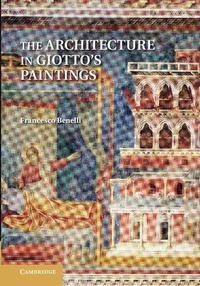
The Architecture in Giotto's Paintings
Published on 14. July 2014
Book
Paperback/Softback
296 pages
978-1-107-69943-4 (ISBN)
Description
This book offers an analysis of Giotto's painted architecture, focusing on issues of structural logic, clarity of composition, and its role within the narrative of the painting. Giotto was the first artist since antiquity to feature highly-detailed architecture in a primary role in his paintings. Francesco Benelli demonstrates how architecture was used to create pictorial space, one of Giotto's key inventions. He argues that Giotto's innovation was driven by a new attention to classical sources, including low reliefs, mosaics, mural paintings, coins, and Roman ruins. The book shows how Giotto's images of fictive buildings, as well as portraits of well-known monuments, both ancient and contemporary, play an important role in the overall narrative, iconography, and meaning of his works. The conventions established by Giotto remained at the heart of early modern Italian painting until the sixteenth century.
Reviews / Votes
'Benelli argues well ...' The Art NewspaperMore details
Language
English
Place of publication
Cambridge
United Kingdom
Target group
College/higher education
Product notice
Paperback (trade)
Illustrations
10 Plates, color; 108 Halftones, unspecified
Dimensions
Height: 254 mm
Width: 178 mm
Thickness: 17 mm
Weight
572 gr
ISBN-13
978-1-107-69943-4 (9781107699434)
Copyright in bibliographic data and cover images is held by Nielsen Book Services Limited or by the publishers or by their respective licensors: all rights reserved.
Schweitzer Classification
Other editions
Additional editions
Francesco Benelli
The Architecture in Giotto's Paintings
Book
12/2011
Cambridge University Press
€150.10
Shipment within 15-20 days
Person
Francesco Benelli is Associate Professor of Renaissance Architecture in the Department of Art History and Archaeology at Columbia University. He was the recipient of the Mellon Postdoctoral Fellowship at Columbia University and a Fellow at the Kunsthistorisches Institut in Florence. He has published widely on several aspects of Renaissance architecture, as well as on issues of building material and technique and the history of design and construction.
Content
Introduction; 1. The cycle of the Legend of San Francis in the upper church of Assisi; 2. The Enrico Scrovegni chapel in Padua; 3. The Peruzzi and Bardi chapels in the church of Santa Croce in Florence; 4. The lower church of Assisi; 5. Giotto's influence in the lower church of Assisi and the church of Santa Croce in Florence; 6. Excursus; Conclusion.