

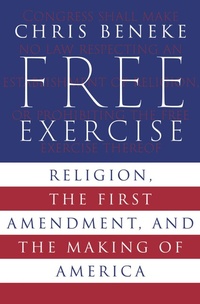
Free Exercise
Religion, the First Amendment, and the Making of America
Published on 13. January 2025
Book
Hardback
256 pages
978-0-19-776702-3 (ISBN)
Description
CONGRESS SHALL MAKE NO LAW RESPECTING AN ESTABLISHMENT OF RELIGION, OR PROHIBITING THE FREE EXERCISE THEREOF. Those words, scratched on parchment in 1789, open the U.S. Constitution's First Amendment. From them, countless interpretations have been drawn. As a consequence, an astonishing variety of activities in modern America-prayer after football games, Bible reading in classrooms, company healthcare policies, the baking of wedding cakes, and Ten Commandment displays around courthouses-have been alternately authorized, prohibited, or modified.
In this compelling historical account, Chris Beneke explains how the religion clauses came into existence and how they were woven into American culture. He brings prominent early national figures to life, including George Washington, James Madison, and Thomas Paine, while chronicling the First Amendment's relationship to defining social conditions like slavery, civility, family life, and the free market. Beneke probes what kind of nation America was when the religion clauses were framed and what kind of nation it was becoming.
Going beyond traditional church-state scholarship, Beneke also demonstrates how white women, African Americans, Roman Catholics, Jews, and nonbelievers widened religious liberty's application and illuminated its boundaries. In doing so he makes a groundbreaking contribution to both constitutional history and the history of American pluralism.
In this compelling historical account, Chris Beneke explains how the religion clauses came into existence and how they were woven into American culture. He brings prominent early national figures to life, including George Washington, James Madison, and Thomas Paine, while chronicling the First Amendment's relationship to defining social conditions like slavery, civility, family life, and the free market. Beneke probes what kind of nation America was when the religion clauses were framed and what kind of nation it was becoming.
Going beyond traditional church-state scholarship, Beneke also demonstrates how white women, African Americans, Roman Catholics, Jews, and nonbelievers widened religious liberty's application and illuminated its boundaries. In doing so he makes a groundbreaking contribution to both constitutional history and the history of American pluralism.
More details
Language
English
Place of publication
New York
United States
Target group
Professional and scholarly
Product notice
sewn/stitched
Cloth over boards
Dimensions
Height: 226 mm
Width: 152 mm
Thickness: 5 mm
Weight
499 gr
ISBN-13
978-0-19-776702-3 (9780197767023)
Copyright in bibliographic data and cover images is held by Nielsen Book Services Limited or by the publishers or by their respective licensors: all rights reserved.
Schweitzer Classification
Other editions
Additional editions
E-Book
09/2024
OUP eBook
€24.99
Available for download
E-Book
09/2024
OUP eBook
€24.99
Available for download
Person
Chris Beneke is professor of History and Associate Dean for the First Year Experience and the Bentley Core at Bentley University. He has written extensively about the history of religious toleration, as well as essays on politics, religion, and sports for The Atlantic, The Chronicle of Higher Education, The New Republic, and The Washington Post.
Content
PREFACE
INTRODUCTION
ONE. Changes
TWO. Duties
THREE. Cruelties
FOUR. Civilities
FIVE. Inequalities
SIX. Infidels
EPILOGUE
INTRODUCTION
ONE. Changes
TWO. Duties
THREE. Cruelties
FOUR. Civilities
FIVE. Inequalities
SIX. Infidels
EPILOGUE