

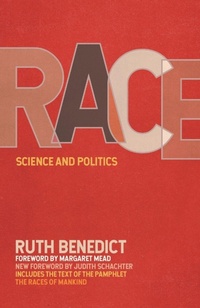
Race
Science and Politics
Published on 15. October 2019
Book
Paperback/Softback
240 pages
978-0-8203-5678-5 (ISBN)
Description
In science, race can be a useful concept-for specific, limited purposes. When race, as a way of classifying people, is drafted into the service of politics, religion, or any belief system, then danger follows. That is the focus of this classic repudiation of racism, which is as readable and timely now as when it first appeared.
Race: Science and Politics was first published in 1940, in response to the global rise of fascism and its pseudoscientific rationales for marginalizing and even exterminating "inferior" people. Writing for a general audience, Ruth Benedict ranges across the history of Western thought and research on race to illuminate rifts between the facts of race and the claims of racism. Rather than take issue only with the Nazis and their allies, Benedict set out to show that all racist beliefs are objectively groundless-and that is the key to the book's ongoing relevance.
The book's bonus content includes The Races of Mankind, a pamphlet-length distillation of the book with its own controversial role in dismantling racist theory. This edition also includes a new foreword by Judith Schachter. An anthropologist, historian, and Benedict biographer, Schachter discusses the book's importance for current readers. Also included is a foreword by anthropologist Margaret Mead from 1958, a time when colonial ties around the world were unravelling and civil rights unrest was a daily occurrence in the United States.
Race: Science and Politics was first published in 1940, in response to the global rise of fascism and its pseudoscientific rationales for marginalizing and even exterminating "inferior" people. Writing for a general audience, Ruth Benedict ranges across the history of Western thought and research on race to illuminate rifts between the facts of race and the claims of racism. Rather than take issue only with the Nazis and their allies, Benedict set out to show that all racist beliefs are objectively groundless-and that is the key to the book's ongoing relevance.
The book's bonus content includes The Races of Mankind, a pamphlet-length distillation of the book with its own controversial role in dismantling racist theory. This edition also includes a new foreword by Judith Schachter. An anthropologist, historian, and Benedict biographer, Schachter discusses the book's importance for current readers. Also included is a foreword by anthropologist Margaret Mead from 1958, a time when colonial ties around the world were unravelling and civil rights unrest was a daily occurrence in the United States.
Reviews / Votes
Speaking as a true humanitarian who sees the broader aspects of the issue, Benedict warns that racial discrimination has become a political machine, used to justify every kind of persecution and exploitation. . . . Benedict is a sane optimist, and her book is worthy of being reprinted again and again-as long as racial bigotry persists. -- Nona Balakian * New York Times * Benedict exposes the stubborn fallacies of race prejudice and pleads for the kind of democracy that must eventually liquidate them. A tract for the times, and a genuine contribution to sound popular knowledge. * New Republic * An admirable book. * New Yorker * Benedict effectively exposes the illusion that there is any scientific basis, anthropological or hereditary, for the Nazi religion of race. -- George S. Mahan * America * Benedict commands a thoroughly disciplined style which enables her to expound technical matters without heaviness or condescension. -- Jacques Barzun * The Nation * Excellent . . . It is well written and useful to the layman as well as to the scholar. * Social Forces * A convincing refutation of the racialist position and a well-rounded statement of many aspects of our scientific knowledge concerning race. . . . In its broad outline and historic sweep the book will present new ideas to those who have already given thought to the nature of race differences. -- Melville J. Herskovits * Jewish Social Studies * This is a clear exposition by a noted anthropologist of the distinction between race and racism. One is science; the other is propaganda. -- J. H. Landman * American Sociological Review * This is a distinctly worthwhile book on a timely topic. . . . Race prejudice smolders perennially and erupts periodically. . . . Benedict has written another exposure of its fallacies, but on her own showing there is little prospect that she has exorcised for good and all its evil spirit. -- Frank H. Hankins * Annals of the American Academy of Political and Social Science *More details
Language
English
Place of publication
Georgia
United States
Target group
Professional and scholarly
Product notice
Paperback (trade)
Illustrations
1 Maps; 1 Maps; 1 Maps; 1 Maps; 1 Maps; 1 Maps; 1 Maps
Dimensions
Height: 198 mm
Width: 129 mm
Thickness: 15 mm
Weight
293 gr
ISBN-13
978-0-8203-5678-5 (9780820356785)
Copyright in bibliographic data and cover images is held by Nielsen Book Services Limited or by the publishers or by their respective licensors: all rights reserved.
Schweitzer Classification
Other editions
Additional editions
E-Book
10/2019
University of Georgia Press
€31.99
Available for download
Persons
RUTH BENEDICT (1887-1948) was a prominent American anthropologist, a protegee of Franz Boas, and a contemporary (and close friend) of Margaret Mead. Benedict's other major books include Patterns of Culture and The Chrysanthemum and the Sword. She was also an accomplished poet, often writing under the pseudonym Anne Singleton.