

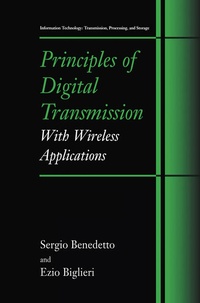
Principles of Digital Transmission
With Wireless Applications
Published on 31. July 1999
Book
Hardback
XIX, 855 pages
978-0-306-45753-1 (ISBN)
Description
Principles of Digital Transmission
is designed for advanced undergraduate and graduate level students and professions in telecommunications. Teachers and learners can mix and match chapters to create four distinct courses: (1) a one-term basic course in digital communications; (2) a one-term course in advanced digital communications; (3) a one-term course in information theory and coding; (4) a two-term course sequence in digital communications and coding.
The book provides rigorous mathematical tools for the analysis and design of digital transmission systems. The authors emphasize methodology in their aim to teach the reader how to do it rather than how it is done . They apply the fundamental tools of the discipline onto a number of systems, such as wireless data transmission systems.
The book provides rigorous mathematical tools for the analysis and design of digital transmission systems. The authors emphasize methodology in their aim to teach the reader how to do it rather than how it is done . They apply the fundamental tools of the discipline onto a number of systems, such as wireless data transmission systems.
Reviews / Votes
From the preface:` ... we hope that those who liked the previous book will find again its flavor here, while new readers, untouched by nostalgia, will judge it favorably. '
More details
Series
Edition
1999 ed.
Language
English
Place of publication
New York
United States
Publishing group
Springer Science+Business Media
Target group
Professional and scholarly
Product notice
sewn/stitched
Cloth over boards
Illustrations
XIX, 855 p.
Dimensions
Height: 234 mm
Width: 158 mm
Thickness: 45 mm
Weight
1288 gr
ISBN-13
978-0-306-45753-1 (9780306457531)
DOI
10.1007/b117711
Schweitzer Classification
Other editions
Additional editions
Book
05/2013
Springer
€299.59
Shipment within 15-20 days
Content
and motivation.- A mathematical introduction.- Basic results from information theory.- Waveform transmission over the Gaussian Channel.- Digital modulation schemes.- Modulations for the wireless channel.- Intersymbol interference channels.- Adaptive receivers and channel equalization.- Carrier and clock synchronization.- Improving the transmission reliability: Block codes.- Convolutional and concatenated codes.- Coded modulation.- Digital transmission over fading channels.- Digital transmission over nonlinear channels.- Useful formulas and approximations.- Some facts from matrix theory.- Variational techniques and constrained optimization.- Transfer functions of directed graphs.- Approximate computation of averages.- Viterbi algorithm.