

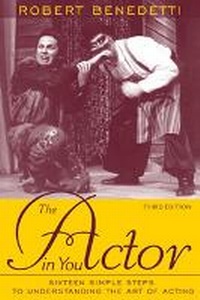
The Actor in You
3rd Edition
Published on 10. January 2005
Book
Paperback/Softback
160 pages
978-0-205-47980-1 (ISBN)
Description
The Actor in You enhances the reader's appreciation of the art of acting by helping them realize that they already possess, in principle, the following skills: the ability to play a role, the ability to fulfill the sense of drama and to structure dramatic scenes, and the capacity to express emotion. Without losing its simplicity, directness, and enjoyable writing style, this revised and enlarged edition has benefited from helpful suggestions by teachers who have used it successfully in the classroom. Drawing exercises and examples from readers' everyday lives and from well-known films and television programs, Benedetti succeeds in deducing dramatic principles from those experiences and then applying them to everyday life for artistic purpose.
More details
Edition
3rd edition
Language
English
Place of publication
United States
Publishing group
Pearson Education (US)
Target group
Professional and scholarly
Dimensions
Height: 229 mm
Width: 152 mm
Weight
265 gr
ISBN-13
978-0-205-47980-1 (9780205479801)
Copyright in bibliographic data and cover images is held by Nielsen Book Services Limited or by the publishers or by their respective licensors: all rights reserved.
Schweitzer Classification
Other editions
New editions
Book
02/2008
4th Edition
Pearson
€77.03
Article exhausted; check for reprint
Content
Each Part and Chapter concludes with "Summary."
Preface.
I. UNDERSTANDING ACTING.
Why Study Acting?
1. What Does an Actor Do?
Acting in Everyday Life
The Tradition of the Actor
Getting into the Tradition
2. Action in Life and in Performance.
Action in Everyday Life
Action and Drama
Believability in Life and in Performance
3. Internal and External Action.
Interactions
4. Understanding Emotion and Character.
Emotion
Character and the Magic If
The Actor in You
5. The Actor's State of Mind.
Dual Consciousness
Indicating
II. PREPARING YOURSELF TO ACT.
The Creative State
6. Relaxation and Centering.
Relaxation
Finding Center
7. Breathing, Sound, and Moving from Center.
Your Relationship to Gravity
The Cycle of Energy
8. Creating Together.
Creating a Scene
III. PREPARING TO REHEARSE: ANALYZING THE SCRIPT.
Discipline
The Purpose of Analysis
Sample Scenes
A Scene of Your Own
9. Dramatic Function.
Supporting Characters and Individual Scenes
Function and Recognition Traits
10. Play and Scene Structure.
Finding the Crisis
Units and Levels of Action
11. The Given Circumstances.
Who
Where
When
What
IV. REHEARSAL.
Getting and Giving Notes
12. Personalization.
Emotional Recall and Substitution
13. Inner Action.
The Stimulus
Automatic and Spontaneous Actions
Choice
The Inner Monologue
14. Actions and Objectives.
Defining Useful Objectives
Playable Actions
Direct and Indirect Action: Subtext
Not Doing
Obstacles and Counter-Actions
15. Scenario, Score, Through-Line, and Superobjective.
The Score
Through-Line and Superobjective
Personalizing the Superobjective
16. Final Rehearsals and Performance.
Blocking
Shaping and Pacing
Spontaneity
Emotion in Performance
Evaluating Your Work
Afterword: Your Sense of Purpose.
Appendix A: Sample Scenes.
Scene 1: From The Glass Menagerie by Tennessee Williams
Scene 2: From A Raisin in the Sun by Lorraine Hansberry
Scene 3: From Zoot Suit by Luis Valdez
Scene 4: From Cheers by Tom Reeder
Appendix B: Suggested Plays and Anthologies.
Plays
Play Anthologies
Anthologies for Students of Color
Glossary.
Index.
Preface.
I. UNDERSTANDING ACTING.
Why Study Acting?
1. What Does an Actor Do?
Acting in Everyday Life
The Tradition of the Actor
Getting into the Tradition
2. Action in Life and in Performance.
Action in Everyday Life
Action and Drama
Believability in Life and in Performance
3. Internal and External Action.
Interactions
4. Understanding Emotion and Character.
Emotion
Character and the Magic If
The Actor in You
5. The Actor's State of Mind.
Dual Consciousness
Indicating
II. PREPARING YOURSELF TO ACT.
The Creative State
6. Relaxation and Centering.
Relaxation
Finding Center
7. Breathing, Sound, and Moving from Center.
Your Relationship to Gravity
The Cycle of Energy
8. Creating Together.
Creating a Scene
III. PREPARING TO REHEARSE: ANALYZING THE SCRIPT.
Discipline
The Purpose of Analysis
Sample Scenes
A Scene of Your Own
9. Dramatic Function.
Supporting Characters and Individual Scenes
Function and Recognition Traits
10. Play and Scene Structure.
Finding the Crisis
Units and Levels of Action
11. The Given Circumstances.
Who
Where
When
What
IV. REHEARSAL.
Getting and Giving Notes
12. Personalization.
Emotional Recall and Substitution
13. Inner Action.
The Stimulus
Automatic and Spontaneous Actions
Choice
The Inner Monologue
14. Actions and Objectives.
Defining Useful Objectives
Playable Actions
Direct and Indirect Action: Subtext
Not Doing
Obstacles and Counter-Actions
15. Scenario, Score, Through-Line, and Superobjective.
The Score
Through-Line and Superobjective
Personalizing the Superobjective
16. Final Rehearsals and Performance.
Blocking
Shaping and Pacing
Spontaneity
Emotion in Performance
Evaluating Your Work
Afterword: Your Sense of Purpose.
Appendix A: Sample Scenes.
Scene 1: From The Glass Menagerie by Tennessee Williams
Scene 2: From A Raisin in the Sun by Lorraine Hansberry
Scene 3: From Zoot Suit by Luis Valdez
Scene 4: From Cheers by Tom Reeder
Appendix B: Suggested Plays and Anthologies.
Plays
Play Anthologies
Anthologies for Students of Color
Glossary.
Index.