

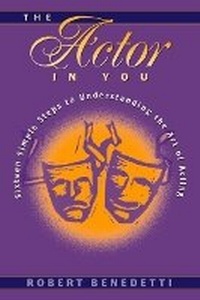
The Actor in You
Sixteen Simple Steps to Understanding the Art of Acting
Published on 3. June 1999
Book
Paperback/Softback
149 pages
978-0-205-26999-0 (ISBN)
Description
An introduction to the fundamentals of beginning acting, The Actor in You enhances students' appreciation of the art of acting by helping them realize that they already possess, in principle, the basic skills of the actor: the ability to play a role, the ability to fulfill the sense of drama and to structure dramatic scenes, and the capacity to express emotion. Drawing exercises and examples from students' everyday lives and from well-known films and television programs, Robert Benedetti succeeds in deducing dramatic principles from those experiences and then applying them to everyday life for artistic purpose. Written in a personal and direct style, Benedetti presents a balance of theory and practical application in a clear and accessible format. Through a sixteen step organization, The Actor in You provides a direct, concise presentation and explanation of fundamentals for beginning students.
More details
Language
English
Place of publication
United States
Publishing group
Pearson Education (US)
Target group
Professional and scholarly
Dimensions
Height: 229 mm
Width: 153 mm
Thickness: 12 mm
Weight
267 gr
ISBN-13
978-0-205-26999-0 (9780205269990)
Copyright in bibliographic data and cover images is held by Nielsen Book Services Limited or by the publishers or by their respective licensors: all rights reserved.
Schweitzer Classification
Other editions
New editions
Book
06/2002
2nd Edition
Pearson
€46.03
Article is exhausted; no reprint
Content
Preface.
I.UNDERSTANDING ACTING.
Why Study Acting?
1.What Does an Actor Do?
Acting in Everyday Life.
2.Action in Life and in Performance.
Action in Everyday Life.
Believability in Life and in Performance.
3.Internal and External Action.
Transactions.
4.Understanding Emotion and Character.
Emotion.
Character and the Magic If.
The Actor in You.
5.The Actor's State of Mind.
Dual Consciousness.
Indicating.
Summary to Part I.II.PREPARING YOURSELF TO ACT.
The Creative State.
6.Tension, Effort, and Relaxation.
Being Whole.
Relaxation.
7.Creating Together.III.CREATING A ROLE.
The Acting Process.
A Scene of Your Own.
Sample Scenes.
8.Dramatic Function.
Functional and Likeness Traits.
9.The Character's World.
Who.
Where.
When.
What.
Summary of the Givens.
10.The Character's Needs.
Personalizing and the Magic If.
Emotional Recall and Substitution.
11.The Character's Mind.
The Stimulus.
Automatic Actions.
Choice.
Working with Inner Action.
12.Objectives and Actions.
Defining Useful Objectives.
Playable Actions.
Direct and Indirect Action: Subtext.
Not Doing.
Connecting Action with Others.
13.Beats and Scene Structure.
Levels of Action.
Scene Structure.
Scene Breakdown.
14.Through-Line and Superobjective.
Personalizing the Superobjective.
15.The Elements of Characterization.
Physical Traits.
Social Traits.
Psychological Traits.
Moral Traits.
Economy of Characterization.
16.Final Rehearsals.
Blocking.
Shaping and Pacing.
Spontaneity.
Emotion in Performance.
Afterword:
The Power of Transformation.
Appendix A:
Sample Scenes.
Appendix B:
Useful Plays.
Glossary.Index.
I.UNDERSTANDING ACTING.
Why Study Acting?
1.What Does an Actor Do?
Acting in Everyday Life.
2.Action in Life and in Performance.
Action in Everyday Life.
Believability in Life and in Performance.
3.Internal and External Action.
Transactions.
4.Understanding Emotion and Character.
Emotion.
Character and the Magic If.
The Actor in You.
5.The Actor's State of Mind.
Dual Consciousness.
Indicating.
Summary to Part I.II.PREPARING YOURSELF TO ACT.
The Creative State.
6.Tension, Effort, and Relaxation.
Being Whole.
Relaxation.
7.Creating Together.III.CREATING A ROLE.
The Acting Process.
A Scene of Your Own.
Sample Scenes.
8.Dramatic Function.
Functional and Likeness Traits.
9.The Character's World.
Who.
Where.
When.
What.
Summary of the Givens.
10.The Character's Needs.
Personalizing and the Magic If.
Emotional Recall and Substitution.
11.The Character's Mind.
The Stimulus.
Automatic Actions.
Choice.
Working with Inner Action.
12.Objectives and Actions.
Defining Useful Objectives.
Playable Actions.
Direct and Indirect Action: Subtext.
Not Doing.
Connecting Action with Others.
13.Beats and Scene Structure.
Levels of Action.
Scene Structure.
Scene Breakdown.
14.Through-Line and Superobjective.
Personalizing the Superobjective.
15.The Elements of Characterization.
Physical Traits.
Social Traits.
Psychological Traits.
Moral Traits.
Economy of Characterization.
16.Final Rehearsals.
Blocking.
Shaping and Pacing.
Spontaneity.
Emotion in Performance.
Afterword:
The Power of Transformation.
Appendix A:
Sample Scenes.
Appendix B:
Useful Plays.
Glossary.Index.