


The Handbook of Behavioral Operations Management
Social and Psychological Dynamics in Production and Service Settings
Published on 25. June 2015
Book
Hardback
442 pages
978-0-19-935721-5 (ISBN)
Description
Over the last decade there has been an explosion of academic interest in the study of Behavioral Operations (Behavioral Ops). Simultaneous concerns have emerged about the adequacy with which now established Behavioral Ops phenomena are dealt with in degree-granting programs and corporate training agendas. Concerns stem from two points:
(1) Pedagogical lessons regarding human behavioral are largely cast in the perspectives and terminology of underlying social/psychological theories. This has traditionally made it difficult for teachers of operations management content to link such knowledge to OM teaching plans and materials.
(2) Games are seen as a major contribution to Behavioral Operations education, but experiments as described in literature are usually used for scientific research, and often difficult to replicate in teaching settings due to the use of unique proprietary software or insufficient descriptions of methods and materials used.
Prior to now, no comprehensive teaching-oriented overview of Behavioral Operations has been available. The Handbook of Behavioral Operations fills this gap, providing easy to access insights into why associated behavioral phenomena exist in specific production and service settings, ready-to-play games and activities that allow instructors to demonstrate the phenomena in class settings, and applicable prescriptions for practice. By design the text serves a dual role as a desk/training reference to those practitioners already in the field, and presents a comprehensive framework for viewing behavioral operations from a systems perspective. As an interdisciplinary book relating the dynamics of human behavior to operations management, the Handbook is an essential resource for practitioners seeking to develop greater system understanding among their workers, as well as for instructors interested in emphasizing the practical relevance of behavior in operational settings.
(1) Pedagogical lessons regarding human behavioral are largely cast in the perspectives and terminology of underlying social/psychological theories. This has traditionally made it difficult for teachers of operations management content to link such knowledge to OM teaching plans and materials.
(2) Games are seen as a major contribution to Behavioral Operations education, but experiments as described in literature are usually used for scientific research, and often difficult to replicate in teaching settings due to the use of unique proprietary software or insufficient descriptions of methods and materials used.
Prior to now, no comprehensive teaching-oriented overview of Behavioral Operations has been available. The Handbook of Behavioral Operations fills this gap, providing easy to access insights into why associated behavioral phenomena exist in specific production and service settings, ready-to-play games and activities that allow instructors to demonstrate the phenomena in class settings, and applicable prescriptions for practice. By design the text serves a dual role as a desk/training reference to those practitioners already in the field, and presents a comprehensive framework for viewing behavioral operations from a systems perspective. As an interdisciplinary book relating the dynamics of human behavior to operations management, the Handbook is an essential resource for practitioners seeking to develop greater system understanding among their workers, as well as for instructors interested in emphasizing the practical relevance of behavior in operational settings.
Reviews / Votes
This Handbook provides a comprehensive overview of this newly-emerging field, including contributions from the leading researchers and spanning both the core disciplines (psychology, organizational behavior, economics, and system dynamics) and the core operations management subfields (scheduling, service operations, supply chains, and inventory). The learning activity chapters provide instructors the resources they need to illustrate these important concepts to their students and themselves. This is an outstanding resource that will be of value to researchers, instructors, and practitioners. * Rachel Croson, Dean, College of Business, University of Texas, Arlington * This Handbook brings together the latest thinking from leading scholars in the emerging field of behavioral operations. It serves as a foundation to both the theory and practice of behavioral operations. * Kevin Linderman, Carlson School of Management, University of Minnesota *More details
Other editions
Additional editions
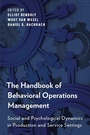
Elliot Bendoly | Wout Van Wezel | Daniel G. Bachrach
The Handbook of Behavioral Operations Management
Social and Psychological Dynamics in Production and Service Settings
Book
06/2015
Oxford University Press Inc
€75.30
Shipment within 15-20 days
Elliot Bendoly | Wout Van Wezel | Daniel G. Bachrach
The Handbook of Behavioral Operations Management
Social and Psychological Dynamics in Production and Service Settings
E-Book
05/2015
1st Edition
OUP eBook
€47.49
Available for download
Elliot Bendoly | Wout Van Wezel | Daniel G. Bachrach
The Handbook of Behavioral Operations Management
Social and Psychological Dynamics in Production and Service Settings
E-Book
05/2015
1st Edition
OUP eBook
€47.49
Available for download
Persons
Dr. Elliot Bendoly is a Professor of Management Sciences at the Fisher College of Business, of the Ohio State University. Before joining Fisher, Dr. Bendoly was the Caldwell Research Fellow and Associate Professor in Information Systems and Operations Management at the Goizueta Business School of Emory University. He serves as Senior Editor at the Production and Operations Management journal (Behavioral Operations and Management of Technology departments) and as Associate Editor for the Journal of Operations Management. His 50+ peer-reviewed articles also appear in Information Systems Research, MIS Quarterly and Journal of Applied Psychology.
Dr. Wout van Wezel is Assistant Professor Operations Management, University of Groningen, The Netherlands. Through a Behavioral Operations lens, he employs various methodologies to investigate how people think, work, coordinate, and cooperate. Dr. van Wezel is co-editor of the book 'Planning in Intelligent Systems' (Wiley), and his peer-reviewed articles appear in, among others, Journal of Operations Management, Decision Support Systems, and International Journal of Operations and Production Management.
Dr. Daniel Bachrach is a Professor of Organizational Behavior and Human Resource Management at the Culverhouse College of Commerce of the University of Alabama. He serves on the Editorial Boards of the Journal of Applied Psychology and Organizational Behavior and Human Decision processes. Professor Bachrach is coauthor of three books, including a leading Principles of Management textbook, Management 13e (Wiley); Transformative Selling: Becoming a Resource Manager and a Knowledge Broker (Wessex); and 10 Don'ts on Your Digital Devices The Non-Techie's Survival Guide to Cyber Security and Privacy (Apress). His 40+ peer-reviewed articles also appear in Organization Science, Journal of Applied Psychology, Strategic Management Journal, Personnel Psychology, Organizational Behavior and Human Decision Processes, and Journal of Operations Management.
Dr. Wout van Wezel is Assistant Professor Operations Management, University of Groningen, The Netherlands. Through a Behavioral Operations lens, he employs various methodologies to investigate how people think, work, coordinate, and cooperate. Dr. van Wezel is co-editor of the book 'Planning in Intelligent Systems' (Wiley), and his peer-reviewed articles appear in, among others, Journal of Operations Management, Decision Support Systems, and International Journal of Operations and Production Management.
Dr. Daniel Bachrach is a Professor of Organizational Behavior and Human Resource Management at the Culverhouse College of Commerce of the University of Alabama. He serves on the Editorial Boards of the Journal of Applied Psychology and Organizational Behavior and Human Decision processes. Professor Bachrach is coauthor of three books, including a leading Principles of Management textbook, Management 13e (Wiley); Transformative Selling: Becoming a Resource Manager and a Knowledge Broker (Wessex); and 10 Don'ts on Your Digital Devices The Non-Techie's Survival Guide to Cyber Security and Privacy (Apress). His 40+ peer-reviewed articles also appear in Organization Science, Journal of Applied Psychology, Strategic Management Journal, Personnel Psychology, Organizational Behavior and Human Decision Processes, and Journal of Operations Management.
Editor
Associate Professor of Informational Systems and Operations Management and Caldwell Research FellowAssociate Professor of Informational Systems and Operations Management and Caldwell Research Fellow, Goizueta Business School, Emory University, Atlanta, Georgia
Assistant ProfessorAssistant Professor, Faculty of Economics and Business, University of Groningen, Netherlands
Associate Professor of Management and Morrow Faculty Excellence FellowAssociate Professor of Management and Morrow Faculty Excellence Fellow, Culverhouse College of Commerce, University of Alabama, Tuscaloosa
Content
Contents ; Introduction to the Handbook ; PART I: BACKGROUND AND THEORETICAL CONSIDERATIONS ; Chapter 1. A Brief History and the Contemporary Knowledge Base ; Chapter 2. The Virtuous Cycles of Experimental Learning ; PART II: LESSONS IN PRODUCTION AND SERVICE CONTEXTS ; Chapter 3. Synch and Swim: Managing and Mismanaging Process Constraints and Variability ; Chapter 4. Process and Perception: Kristen's Cookie Company from a Behavioral Point of View ; Chapter 5. Outflanking Undecided, Ever-Changing Puzzles : The Role of Human Behavior in Scheduling ; Chapter 6. Hitting the Target: Process Control, Experimentation, and Improvement in a Catapult Competition ; Chapter 7. The Wait or Buy Game: How to Game the System That's Designed to Game You Back ; Chapter 8. Seeing the Forest (And Your Tree): Envisioning Motivation and Performance in Work Design ; Chapter 9. Satisfaction Architect: Service Design and Its Behavioral Implications ; Chapter 10. Sharing the Load: Group Behavior and Insights into Simulating Real-World Dynamics ; PART III: LESSONS IN SUPPLY CHAINS AND INTEGRATIVE/ENABLING TECHNOLOGY ; Chapter 11. Booms, Busts, and Beer: Understanding the Dynamics of Supply Chains ; Chapter 12. Kicking the <"Mean>" Habit: Joint Prepositioning in Debiasing Pull-to-Center Effects ; Chapter 13. Sharing the Risk: Understanding Risk-Sharing Contracts from the Supplier's Perspective ; Chapter 14. A Chain of Hands: Pro-Social Integration in a Coffee Supply Chain Setting ; Chapter 15. Supply Chain Negotiator: A Game of Gains, Losses, and Equity ; Chapter 16. ERP Simulator: Examining Competitive Supply Chain Team Dynamics ; Chapter 17. The Fresh Connection: Inter-Functional Integration in Supply Chain Management ; Chapter 18. Wrapping it Up: Behavior and Decision Making Revealed in Business Simulation Games ; Conclusion: Behavioral Operations in Practice and Future Work