

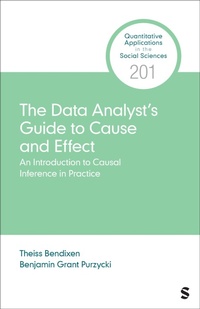
The Data Analyst's Guide to Cause and Effect
An Introduction to Causal Inference in Practice
1st Edition
Will be published approx. on 14. January 2027
Book
Paperback/Softback
168 pages
979-8-3488-4871-2 (ISBN)
Description
The Data Analyst's Guide to Cause and Effect offers a clear, practical roadmap built around the EEESI workflow-Estimand, Estimator, Estimate, Simulation-based Inference. This book provides a systematic approach to defining, estimating, and validating causal effects, allowing readers to learn to apply modern techniques and move beyond simple associations to make credible causal inferences that inform theory, policy, and practice.
Reviews / Votes
The Data Analyst's Guide to Cause and Effect offers an excellent, comprehensive, yet accessible introduction to causal inference. With a light-hearted approach, it opens up a new perspective for those accustomed to traditional statistical analysis, shedding light on crucial aspects of data interpretation. From selecting the right controls to estimating causal effects and even tackling advanced topics like missing data and the intricacies of multilevel modeling, this book is an invaluable guide for analysts seeking to move beyond mere correlation. -- Julia Rohrer The Data Analyst's Guide offers a strongly application-focused introduction to causal inference and is an effective tool for getting data analysts into the world of causal inference and immediately into a workable project. -- Nicholas Huntington-Klein This is a clear and readable book with broad coverage of many ideas and methods in causal inference. -- Andrew GelmanMore details
Series
Edition
First Edition
Language
English
Place of publication
Thousand Oaks
United States
Target group
College/higher education
Product notice
Paperback (trade)
Unsewn / adhesive bound
Dimensions
Height: 216 mm
Width: 140 mm
Thickness: 9 mm
Weight
200 gr
ISBN-13
979-8-3488-4871-2 (9798348848712)
Copyright in bibliographic data and cover images is held by Nielsen Book Services Limited or by the publishers or by their respective licensors: all rights reserved.
Schweitzer Classification
Persons
Theiss Bendixen is a PhD, quantitative consultant, and independent researcher. To date, he has written two popular science books, a co-edited
volume, as well as more than 40 academic works, including tutorials, quantitative empirical papers, and technical commentaries. He consults on statistical modelling in both industry, academia, and non-profits, applying causal inference techniques across scientific disciplines. He currently works in the pharmaceutical sector.
Personal website: www.theissbendixen.com Benjamin Grant Purzycki is Associate Professor at Aarhus University. He is a cognitive and evolutionary cultural anthropologist and focuses on the causal role of various demographic and cultural factors on human cooperation. He has conducted fieldwork in the Tyva Republic (Russia) and managed large, cross-cultural projects. His most recent books include The Minds of Gods: New Horizons in the Naturalistic Study of Religion (Bloomsbury), Ethnographic Free-List Data (Sage), and Morality and the Gods (Cambridge University Press).
Personal website: www.bgpurzycki.wordpress.com
volume, as well as more than 40 academic works, including tutorials, quantitative empirical papers, and technical commentaries. He consults on statistical modelling in both industry, academia, and non-profits, applying causal inference techniques across scientific disciplines. He currently works in the pharmaceutical sector.
Personal website: www.theissbendixen.com Benjamin Grant Purzycki is Associate Professor at Aarhus University. He is a cognitive and evolutionary cultural anthropologist and focuses on the causal role of various demographic and cultural factors on human cooperation. He has conducted fieldwork in the Tyva Republic (Russia) and managed large, cross-cultural projects. His most recent books include The Minds of Gods: New Horizons in the Naturalistic Study of Religion (Bloomsbury), Ethnographic Free-List Data (Sage), and Morality and the Gods (Cambridge University Press).
Personal website: www.bgpurzycki.wordpress.com
Content
About the Authors
Series Editor's Introduction
Acknowledgments
Chapter 1: Introduction
The fundamental promise of causal inference
Causal inference is "EEESI"
The R programming language
Formal notation
Chapter objectives
Further reading
Chapter 2: Causal Graphs
Randomizing a DAG
Elementary ingredients of DAGs
Good and bad controls
Where do DAGs come from?
Average people and people on average
Chapter objectives
Further reading
Chapter 3: G-methods and Marginal Effects
Inverse probability weighting
G-computation
It's assumptions all the way down
Chapter objectives
Further reading
Chapter 4: Adventures in G-methods
Doubly robust estimation
Sub-group analysis
Complex longitudinal designs
Mediation analysis: Crossing hypothetical worlds
Chapter objectives
Further reading
Chapter 5: Most of Your Data is Almost Always Missing
External validity and selection bias
Poststratification
The treatment effects zoo
Target populations and econometrics
Chapter objectives
Further reading
Chapter 6: More Missing Data
To be or not to be missing
Completely random terminology
Missing data imputation
Chapter objectives
Further reading
Chapter 7: Multilevel modelling and Mundlak's legacy
Causal inference as counterfactual prediction
Mundlak models
Marginal effects in a multilevel model
Chapter objectives
Further reading
Chapter 8: Causal Inference is not Easy
Violations of identification assumptions and some solutions
Bayesian causal modelling
Perspectives on RCT data analysis
Causal inference in the era of Big Data and AI
Conclusion
References
Index
Series Editor's Introduction
Acknowledgments
Chapter 1: Introduction
The fundamental promise of causal inference
Causal inference is "EEESI"
The R programming language
Formal notation
Chapter objectives
Further reading
Chapter 2: Causal Graphs
Randomizing a DAG
Elementary ingredients of DAGs
Good and bad controls
Where do DAGs come from?
Average people and people on average
Chapter objectives
Further reading
Chapter 3: G-methods and Marginal Effects
Inverse probability weighting
G-computation
It's assumptions all the way down
Chapter objectives
Further reading
Chapter 4: Adventures in G-methods
Doubly robust estimation
Sub-group analysis
Complex longitudinal designs
Mediation analysis: Crossing hypothetical worlds
Chapter objectives
Further reading
Chapter 5: Most of Your Data is Almost Always Missing
External validity and selection bias
Poststratification
The treatment effects zoo
Target populations and econometrics
Chapter objectives
Further reading
Chapter 6: More Missing Data
To be or not to be missing
Completely random terminology
Missing data imputation
Chapter objectives
Further reading
Chapter 7: Multilevel modelling and Mundlak's legacy
Causal inference as counterfactual prediction
Mundlak models
Marginal effects in a multilevel model
Chapter objectives
Further reading
Chapter 8: Causal Inference is not Easy
Violations of identification assumptions and some solutions
Bayesian causal modelling
Perspectives on RCT data analysis
Causal inference in the era of Big Data and AI
Conclusion
References
Index