

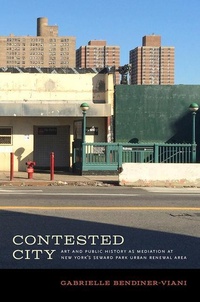
Contested City
Art and Public History as Mediation at New York's Seward Park Urban Renewal Area
Published on 3. January 2019
Book
Paperback/Softback
234 pages
978-1-60938-610-8 (ISBN)
Description
For forty years, as New York's Lower East Side went from disinvested to gentrified, residents lived with a wound at the heart of the neighborhood, a wasteland of vacant lots known as the Seward Park Urban Renewal Area (SPURA). Most of the buildings on the fourteen-square-block area were condemned in 1967, displacing thousands of low-income people of color with the promise that they would soon return to new housing-housing that never came.
Over decades, efforts to keep out affordable housing sparked deep-rooted enmity and stalled development, making SPURA a dramatic study of failed urban renewal, as well as a microcosm epitomizing the greatest challenges faced by American cities since World War II.
Artist and urban scholar Gabrielle Bendiner-Viani was invited to enter this tense community to support a new approach to planning, which she accepted using collaboration, community organizing, public history, and public art. Having engaged her students at The New School in a multi-year collaboration with community activists, the exhibitions and guided tours of her Layered SPURA project provided crucial new opportunities for dialogue about the past, present, and future of the neighborhood.
Simultaneously revealing the incredible stories of community and activism at SPURA, and shedding light on the importance of collaborative creative public projects, Contested City bridges art, design, community activism, and urban history. This is a book for artists, planners, scholars, teachers, cultural institutions, and all those who seek to collaborate in new ways with communities.
Over decades, efforts to keep out affordable housing sparked deep-rooted enmity and stalled development, making SPURA a dramatic study of failed urban renewal, as well as a microcosm epitomizing the greatest challenges faced by American cities since World War II.
Artist and urban scholar Gabrielle Bendiner-Viani was invited to enter this tense community to support a new approach to planning, which she accepted using collaboration, community organizing, public history, and public art. Having engaged her students at The New School in a multi-year collaboration with community activists, the exhibitions and guided tours of her Layered SPURA project provided crucial new opportunities for dialogue about the past, present, and future of the neighborhood.
Simultaneously revealing the incredible stories of community and activism at SPURA, and shedding light on the importance of collaborative creative public projects, Contested City bridges art, design, community activism, and urban history. This is a book for artists, planners, scholars, teachers, cultural institutions, and all those who seek to collaborate in new ways with communities.
More details
Series
Language
English
Place of publication
Iowa
United States
Target group
Professional and scholarly
Illustrations
26 black & white images, 16 color
Dimensions
Height: 229 mm
Width: 152 mm
Thickness: 15 mm
Weight
383 gr
ISBN-13
978-1-60938-610-8 (9781609386108)
Copyright in bibliographic data and cover images is held by Nielsen Book Services Limited or by the publishers or by their respective licensors: all rights reserved.
Schweitzer Classification
Person
Dr. Gabrielle Bendiner-Viani is an urbanist, curator, and artist pioneering public arts and urban research for community engagement, and is author of Contested City: Art and Public History as Mediation at New York's Seward Park Urban Renewal Area. She is principal of the design and research studio Buscada (buscada.com) and teaches urban studies and public art at The New School. She was the 2017 Post-doctoral Fellow in Visual Culture at the International Center of Photography and holds a PhD in environmental psychology from the Graduate Center, CUNY. She regularly consults with arts and culture organizations on community and art engagements and strategic visioning. Her creative practice has been shown at institutions including MIT, the Brooklyn Public Library, the Center for Architecture, the Sheila C. Johnson Design Center, and Tate Britain. Her work on cities, culture and photography has appeared in journals including Visual Studies, Urban Omnibus, Space and Culture, Society & Space, and Buildings & Landscapes.