

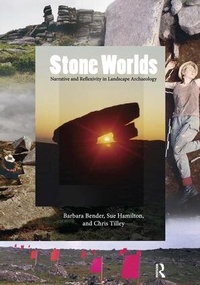
Stone Worlds
Narrative and Reflexivity in Landscape Archaeology
1st Edition
Published on 15. February 2008
Book
Hardback
476 pages
978-1-59874-218-3 (ISBN)
Description
This book represents an innovative experiment in presenting the results of a large-scale, multidisciplinary archaeological project. The well-known authors and their team examined the Neolithic and Bronze Age landscapes on Bodmin Moor of Southwest England, especially the site of Leskernick. The result is a multivocal, multidisciplinary telling of the stories of Bodmin Moor-both ancient and modern-using a large number of literary genres and academic disciplines. Dialogue, storytelling, poetry, photo essays and museum exhibits all appear in the volume, along with contributions from archaeologists, anthropologists, sociologists, geologists, and ecologists. The result is a major synthesis of the Bronze Age settlements and ritual sites of the Moor, contextualized within the Bronze Ages of southwestern and central Britain, and a tracing of the changing meaning of this landscape over the past five thousand years. Of obvious interest to those in British prehistory, this is a substantial presentation of a groundbreaking project that will also be of interest to many concerned with the interpretation of social landscapes and the public presentation of archaeology.
Reviews / Votes
Stone Worlds will become one of the defining texts for the phenomenological approach to prehistoric archaeology. It combines narrative, dialogue, diary entries and photo essays to present sometimes conflicting ideas about human engagement with the ancient landscape, and recent artists (Henry Moore, Andy Goldsworthy) who focus upon setting as central themes in their work. The authors conducted five seasons of fieldwork in Leskernick on Bodmin Moor, Cornwall, setting out to reinterpret the landscape in its contemporary setting. They depart from a singular authoritative definition of the landscape, instead offering it to observers for their own interpretation. Covering stones in cling-film and painting them, as well as having a site poet, they present a vivid re-creation of the Neolithic and Bronze Age settlement and ritual sites of the moor. -Richard Lee, British Archaeology The directors explored the archaeologists' multifaceted perceptions of the excavation landscape. This ethnographic component is a noteworthy advance. An ethnography of archaeology can play a significant role in teasing out our experiences of landscapes and discerning how these experiences shape our understanding and exploration of archaeological sites. These innovations represent important steps towards a more full disclosure of field practice and relationships. In conclusion, this volume.represents a significant movement towards a more reflexive methodology in archeology. The complete review may be read online at: http://wings.buffalo.edu/ARD/cgi/showme.cgi?keycode=3237 http://wings.buffalo.edu/ARD/cgi/showme.cgi?keycode=3237 -Anna Boozer, Anthropology Review DatabaseMore details
Series
Language
English
Place of publication
Walnut Creek
United States
Target group
College/higher education
Professional and scholarly
Illustrations
12 color illus., 120 bw illus.
Dimensions
Height: 254 mm
Width: 178 mm
Weight
453 gr
ISBN-13
978-1-59874-218-3 (9781598742183)
Copyright in bibliographic data and cover images is held by Nielsen Book Services Limited or by the publishers or by their respective licensors: all rights reserved.
Schweitzer Classification
Other editions
Additional editions
Barbara Bender | Sue Hamilton | Christopher Tilley
Stone Worlds
Narrative and Reflexivity in Landscape Archaeology
E-Book
09/2016
Routledge
€73.99
Available for download
Barbara Bender | Sue Hamilton | Christopher Tilley
Stone Worlds
Narrative and Reflexivity in Landscape Archaeology
E-Book
09/2016
Routledge
€73.99
Available for download
Barbara Bender | Sue Hamilton | Christopher Tilley
Stone Worlds
Narrative and Reflexivity in Landscape Archaeology
Book
02/2008
1st Edition
Left Coast Press Inc
€89.32
Shipment within 3-4 weeks
Persons
Christopher Tilley, Barbara Bender, Sue Hamilton
Content
One: Introduction; One One: Stone Worlds, Alternative Narratives, Nested Landscapes; One Two: Bodmin Moor; One Three: Methodologies; Two: The Present Past; Two Four: The Old Sacred Places; Two Five: Leskernick; Two Six: The Western Settlement; Two Seven: Time Goes On; Two Eight: The Shrine Stone; Two Nine: Nature, Culture, Clitter 1; Two: Photo Essay Moving in Procession across Brown Willy; Three: The Present Past; Three Ten: Introduction to the Sociological Study of the Leskernick Project; Three Eleven: The Book and the Trowel; Three Twelve: Where Worlds Collide; Three Thirteen: Art and the Re-Presentation of the Past 1; Four: Beyond the Hill; Four Fourteen: Other Ways of Telling; Four Fifteen: Letting Go; Four Sixteen: Movement across the Moor; Four Seventeen: Between Moor and Plain; Four Eighteen: Beyond the Moor; Four Nineteen: Solution Basins