

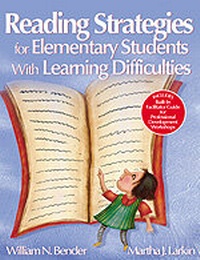
Reading Strategies for Elementary Students With Learning Difficulties
1st Edition
Published on 22. July 2003
Book
Hardback
272 pages
978-0-7619-4658-8 (ISBN)
Description
This book is written with the purpose of providing primary and middle school teachers a practical set of research based instructional strategies primarily for students with learning disabilities, and other learning difficulties. This book includes strategies and instructional examples to be practiced in inclusive classrooms, as well as in one-to-one teaching situations. This book offers a practical, ready reference for teachers' increasingly important role in reading instruction for students with learning disabilities.
More details
Language
English
Place of publication
Thousand Oaks
United States
Publishing group
SAGE Publications Inc
Target group
Professional and scholarly
Product notice
Cloth over boards
Dimensions
Height: 279 mm
Width: 216 mm
Weight
869 gr
ISBN-13
978-0-7619-4658-8 (9780761946588)
Copyright in bibliographic data and cover images is held by Nielsen Book Services Limited or by the publishers or by their respective licensors: all rights reserved.
Schweitzer Classification
Other editions
New editions
William N. Bender | Martha J. Larkin
Reading Strategies for Elementary Students With Learning Difficulties
Strategies for RTI
Book
02/2009
2nd Edition
Corwin Press Inc
€94.90
Shipment within 10-20 days
Persons
William N. Bender, PhD, has had a long and distinguished career in education, teaching in public school for several years and in higher education for some 26 years at Blue?eld State College in West Virginia, Rutgers University in New Jersey, and the University of Georgia. He has written 36 books in special and general education. With his retirement, he has stepped back from his rigorous workshop schedule, which as recently as 2016 included some 40 workshop days per year. While the COVID-19 pandemic impacted his work, he has written four historical ?ction novels and several educational books in recent years. He has delivered several professional development projects, including most recently a keynote for a virtual conference on project-based learning in Brazil in conjunction with his Corwin book Project-Based Learning (2012).
Martha J. Larkin taught public school students in general education and special education at the elementary, middle, and secondary levels for several years before beginning a career in higher education. She has authored and coauthored 17 journal articles, 10 book and monograph chapters, and 5 research reports and commissioned papers in education and special education. She specializes in instructional strategies, particularly for students with learning disabilities. Her specific teaching and research interests include scaffolded instruction, content enhancement, learning strategies, graphic organizers, and grading rubrics. She especially enjoys pursuing these interests in the areas of reading, writing, and mathematics. She earned her PhD from the University of Alabama in 1999.
Martha J. Larkin taught public school students in general education and special education at the elementary, middle, and secondary levels for several years before beginning a career in higher education. She has authored and coauthored 17 journal articles, 10 book and monograph chapters, and 5 research reports and commissioned papers in education and special education. She specializes in instructional strategies, particularly for students with learning disabilities. Her specific teaching and research interests include scaffolded instruction, content enhancement, learning strategies, graphic organizers, and grading rubrics. She especially enjoys pursuing these interests in the areas of reading, writing, and mathematics. She earned her PhD from the University of Alabama in 1999.
Content
Acknowledgments
About the Authors
Introduction
1. The Reading Brain and Literacy Instruction
The Good News in Reading Research!
Big Ideas From Early Literacy Research
The Emerging Emphasis on Literacy
Assessment of Early Literacy
Brain Compatible Reading Instruction
A Brain-Based Model of Reading
What the Brain Research on Reading Has Found
Conclusion
What's Next?
2. Phonemic Instruction: The Critical Emphasis in Reading and Literacy
Phonological Instruction and Phonemic Instruction
Phonemic Awareness or Phonemic Manipulation
Guidelines for Phonemic Instruction
Phonemic-Based Reading Programs
Conclusion
What's Next?
3. Phonics and Word Attack Strategies
Phonics and the Brain
Phonics Instructional Options
Strategies for Developmental Reading and Spelling Stages
Conclusion
What's Next?
4. Strategies for Building Vocabulary and Reading Fluency
Building Vocabulary
The Importance of Vocabulary Development
Do We Still Need Sight-Word Approaches for Vocabulary Instruction?
How Good Readers Read
Learning New Vocabulary Terms
Word Recognition Instruction
Deriving Meaning From Vocabulary
Learning Strategies for Vocabulary Mastery
Reading Fluency
Conclusion
What's Next?
5. Gaining Meaning From Reading
Reading Comprehension and the Brain
Story Grammar
Student Think-Alouds or Inferencing Substrategies
Question Answering
Gist Summaries
Improvisational Drama
Cooperative Discussion and Questioning (Coop-Dis-Q)
Collaborative Strategic Reading (CSR)
Bibliotherapy
Conclusion
What's Next?
6. Reading Comprehension in the Content Areas
Content Area Reading and the Brain
KWPLS (Know, Want to Know, Predict, Learned, Summarize)
Analogies Instruction
Possible Sentences
Vocabulary Self-Collection Strategy (VSS)
Guided Reading in Textual Settings (GRITS)
ReQuest: Asking Self-Declared Questions
Idea Circles
Intra-Act: Sharing Perspectives
Question-Answer Relationships
Conclusion
Resources: Commercially Available Reading Programs - Jana Nylund and William N. Bender
Glossary
Index
Facilitator's Guide
About the Authors
Introduction
1. The Reading Brain and Literacy Instruction
The Good News in Reading Research!
Big Ideas From Early Literacy Research
The Emerging Emphasis on Literacy
Assessment of Early Literacy
Brain Compatible Reading Instruction
A Brain-Based Model of Reading
What the Brain Research on Reading Has Found
Conclusion
What's Next?
2. Phonemic Instruction: The Critical Emphasis in Reading and Literacy
Phonological Instruction and Phonemic Instruction
Phonemic Awareness or Phonemic Manipulation
Guidelines for Phonemic Instruction
Phonemic-Based Reading Programs
Conclusion
What's Next?
3. Phonics and Word Attack Strategies
Phonics and the Brain
Phonics Instructional Options
Strategies for Developmental Reading and Spelling Stages
Conclusion
What's Next?
4. Strategies for Building Vocabulary and Reading Fluency
Building Vocabulary
The Importance of Vocabulary Development
Do We Still Need Sight-Word Approaches for Vocabulary Instruction?
How Good Readers Read
Learning New Vocabulary Terms
Word Recognition Instruction
Deriving Meaning From Vocabulary
Learning Strategies for Vocabulary Mastery
Reading Fluency
Conclusion
What's Next?
5. Gaining Meaning From Reading
Reading Comprehension and the Brain
Story Grammar
Student Think-Alouds or Inferencing Substrategies
Question Answering
Gist Summaries
Improvisational Drama
Cooperative Discussion and Questioning (Coop-Dis-Q)
Collaborative Strategic Reading (CSR)
Bibliotherapy
Conclusion
What's Next?
6. Reading Comprehension in the Content Areas
Content Area Reading and the Brain
KWPLS (Know, Want to Know, Predict, Learned, Summarize)
Analogies Instruction
Possible Sentences
Vocabulary Self-Collection Strategy (VSS)
Guided Reading in Textual Settings (GRITS)
ReQuest: Asking Self-Declared Questions
Idea Circles
Intra-Act: Sharing Perspectives
Question-Answer Relationships
Conclusion
Resources: Commercially Available Reading Programs - Jana Nylund and William N. Bender
Glossary
Index
Facilitator's Guide