

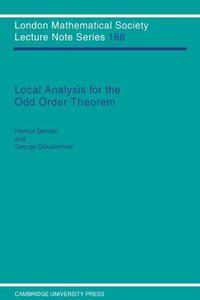
Local Analysis for the Odd Order Theorem
Published on 27. January 1995
Book
Paperback/Softback
188 pages
978-0-521-45716-3 (ISBN)
Description
In 1963 Walter Feit and John G. Thompson published a proof of a 1911 conjecture by Burnside that every finite group of odd order is solvable. This proof, which ran for 255 pages, was a tour-de-force of mathematics and inspired intense effort to classify finite simple groups. This book presents a revision and expansion of the first half of the proof of the Feit-Thompson theorem. Simpler, more detailed proofs are provided for some intermediate theorems. Recent results are used to shorten other proofs. The book will make the first half of this remarkable proof accessible to readers familiar with just the rudiments of group theory.
Reviews / Votes
'This book is written well ... the authors have succeeded both in simplifying the proof of the Odd Order Theorem and in making it accessible to a wider audience.' Paul Flavell, Bulletin of the London Mathematical SocietyMore details
Series
Language
English
Place of publication
Cambridge
United Kingdom
Target group
College/higher education
Product notice
Paperback (trade)
Illustrations
Worked examples or Exercises
Dimensions
Height: 229 mm
Width: 152 mm
Thickness: 10 mm
Weight
282 gr
ISBN-13
978-0-521-45716-3 (9780521457163)
Copyright in bibliographic data and cover images is held by Nielsen Book Services Limited or by the publishers or by their respective licensors: all rights reserved.
Schweitzer Classification
Other editions
Additional editions
Helmut Bender | George Glauberman
Local Analysis for the Odd Order Theorem
E-Book
03/2011
1st Edition
Cambridge University Press
€58.99
Available for download
Previous edition

Helmut Bender | George Glauberman
Local Analysis for the Odd Order Theorem
Book
01/1994
Cambridge University Press
Unfortunately, price unknown
Article exhausted; check for reprint
Persons
Content
Part I. Preliminary Results: 1. Notation and elementary properties of solvable groups; 2. General results on representations; 3. Actions of Frobenius groups and related results; 4. p-Groups of small rank; 5. Narrow p-groups; 6. Additional results; Part II. The Uniqueness Theorem: 7. The transitivity theorem; 8. The fitting subgroup of a maximal subgroup; 9. The uniqueness theorem; Part III. Maximal Subgroups: 10. The subgroups Ma and Me; 11. Exceptional maximal subgroups; 12. The subgroup E; 13. Prime action; Part IV. The Family of All Maximal Subgroups of G: 14. Maximal subgroups of type p and counting arguments; 15. The subgroup Mf; 16. The main results; Appendix; Prerequisites and p-stability.