

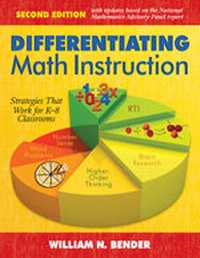
Differentiating Math Instruction
Strategies That Work for K-8 Classrooms
2nd Edition
Published on 6. May 2009
Book
Hardback
152 pages
978-1-4129-7081-5 (ISBN)
Description
'Bender presents a variety of ways to differentiate instruction and foster dynamic learning' - Scott Currier, Mathematics Teacher, Belmont High School, NH
'This is one of those rare opportunities when a teacher can read a book and become inspired to take ideas immediately back to the classroom' - Amanda P. McKee, Math Instructor, Florence GBP5 School District, Johnsonville, SC
Differentiate math instruction with practices that boost mastery for all students!
Experienced teachers understand and appreciate that all students learn and process information according to their individual styles, abilities, and preferences. William N. Bender provides teachers with a wealth of critical strategies and teaching ideas for differentiating instruction to leverage each learner's unique abilities and raise student achievement in math.
With updated information and recommendations based on the 2008 National Mathematics Advisory Panel report, this new edition of Differentiating Math Instruction includes research on the value of brain-compatible teaching and creative ways to get students visualizing, vocalizing, and moving during math to make instruction more meaningful, motivational, and successful. New and seasoned teachers alike will be able to quickly adapt the techniques to suit their specific classrooms, with key features including:
- Strategies for use within a Response to Intervention framework
- At-a-glance lists of "Top Ten Tactics" for successful implementation
- "Web Site Reviews" that outline additional online resources
- Concrete strategies to tap into multiple intelligences
- A facilitator's guide for staff developers to train teachers in differentiating math instruction
Engage every student in a deep conceptual understanding of mathematics with this key resource aimed at revitalizing mathematics instruction in the elementary and middle school classroom.
'This is one of those rare opportunities when a teacher can read a book and become inspired to take ideas immediately back to the classroom' - Amanda P. McKee, Math Instructor, Florence GBP5 School District, Johnsonville, SC
Differentiate math instruction with practices that boost mastery for all students!
Experienced teachers understand and appreciate that all students learn and process information according to their individual styles, abilities, and preferences. William N. Bender provides teachers with a wealth of critical strategies and teaching ideas for differentiating instruction to leverage each learner's unique abilities and raise student achievement in math.
With updated information and recommendations based on the 2008 National Mathematics Advisory Panel report, this new edition of Differentiating Math Instruction includes research on the value of brain-compatible teaching and creative ways to get students visualizing, vocalizing, and moving during math to make instruction more meaningful, motivational, and successful. New and seasoned teachers alike will be able to quickly adapt the techniques to suit their specific classrooms, with key features including:
- Strategies for use within a Response to Intervention framework
- At-a-glance lists of "Top Ten Tactics" for successful implementation
- "Web Site Reviews" that outline additional online resources
- Concrete strategies to tap into multiple intelligences
- A facilitator's guide for staff developers to train teachers in differentiating math instruction
Engage every student in a deep conceptual understanding of mathematics with this key resource aimed at revitalizing mathematics instruction in the elementary and middle school classroom.
Reviews / Votes
"This is one of those rare opportunities when a teacher can read a book and become inspired to take ideas immediately back to the classroom and use them. This book provides an effective plan to help teachers reach all their students using proven and researched strategies. It guides today's classroom teacher who is struggling to help a diverse student population become successful." -- Amanda P. McKee, Math Instructor "This book provides refreshing strategies that work in the classroom. Bender has presented us with a variety of ways to differentiate instruction and foster dynamic learning. This work is a gift to individuals who are constantly looking for ways to improve their practice." -- Scott Currier, Mathematics Teacher "William Bender's book should be a necessity for the bookshelf of anyone who teaches math. It speaks to the educator who may be struggling to reach all math learners in his or her classroom. It also reaches the math coach who is inspired by Bender's work and who wishes to spread this wealth of knowledge to other educators. There is truly something for everybody." -- Carl Ameen Jr., Principal "A fantastic resource for first-year teachers and veterans alike. Bender's research base combines with creativity and multiple approaches to yield a great reference that teachers can use over and over again." -- Randy Wormald, Mathematics Teacher, Belmont High School, NH "The structure of the book invites teachers to enter into the text based on their questions-by design, a differentiated resource! The book is an excellent choice for a study group to begin the conversation on differentiation in mathematics. The inclusion of a facilitator's guide provides further questions and activities for deepening teachers' understanding of differentiation in mathematics." -- Thelma A. Davis, PrincipalMore details
Edition
2nd Revised edition
Language
English
Place of publication
Thousand Oaks
United States
Publishing group
SAGE Publications Inc
Target group
Professional and scholarly
Interest Age: 0 years
Edition type
Revised edition
Dimensions
Height: 279 mm
Width: 216 mm
Weight
652 gr
ISBN-13
978-1-4129-7081-5 (9781412970815)
Copyright in bibliographic data and cover images is held by Nielsen Book Services Limited or by the publishers or by their respective licensors: all rights reserved.
Schweitzer Classification
Other editions
Previous edition
Book
07/2005
1st Edition
Corwin Press Inc
€69.60
Article exhausted; check for reprint
Person
William N. Bender, PhD, has had a long and distinguished career in education, teaching in public school for several years and in higher education for some 26 years at Blue?eld State College in West Virginia, Rutgers University in New Jersey, and the University of Georgia. He has written 36 books in special and general education. With his retirement, he has stepped back from his rigorous workshop schedule, which as recently as 2016 included some 40 workshop days per year. While the COVID-19 pandemic impacted his work, he has written four historical ?ction novels and several educational books in recent years. He has delivered several professional development projects, including most recently a keynote for a virtual conference on project-based learning in Brazil in conjunction with his Corwin book Project-Based Learning (2012).
Content
Preface: How to Use This Book
Acknowledgments
About the Author
1. The Mathematical Brain and High-Impact Teaching
Teaching Mathematics Through Differentiating Instruction
The Mathematical Brain
Brains as Prioritizing Filters
Number Sense
Multiple Intelligences: Avenues for Learning Math
Summary of Brain Research
Instructional Phases for Developing Math Skills
Teaching Strategy: Mathematical Games to Develop Number Sense
SHEMR: A Tool for High-Impact Learning in Mathematics Evaluating One's Own Instructional Planning
What's Next?
2. Differentiated Instruction and Response to Intervention in Mathematics
Differentiation and Response to Intervention: Refocusing Math Instruction
Teaching Phases in the Direct Instruction Lesson
Problems With Direct Instruction in a Large Class
Teaching Strategy: The Guess, Assess, and Tear Out Tactic
A Differentiated Instruction Lesson Example
Teaching Strategy: Using Guess, Assess, and Tear Out! Moving From Direct Instruction to Differentiated Instruction in Math
The Omega Group
The Mainline Instruction Group
The Beta Group
Is Further Differentiation Needed?
Anything Wrong With This Scenario? Enhancing the Differentiated Instruction Model
Guidelines for Differentiated Lesson Planning
Results of Differentiated Lessons
A Differentiated Instruction Overview: What It Is and What It Isn't
Response to Intervention in Mathematics
Case Study: A RTI for Number Sense and Early Math Skill
What's Next?
3. Differentiating for Primary and Elementary Math
Research on Math Readiness
Steps in Developing Early Math Skills
Teaching Strategy: A Concrete, Semi-Concrete, Abstract Learning Tactic
Using CSA in the Classroom
CSA in the Higher Grades
Summary: CSA Tactic
Teaching Strategy: The Errorless Learning Procedures
Summary: Errorless Learning
Teaching Strategy: Classwide Peer Tutoring for Differentiating in the Math Class
What's Next?
4. Differentiating for Deep Conceptual Understanding
High-Impact Teaching for Operations in Math
The Debate on Calculators in Elementary Mathematics
Constructivist Theory and Understanding of Mathematics
Using Cognitive Guided Visualization
Scaffolded Instruction in Math
Debate on What a Scaffold Is
Graphic Representations of Word Problem Schemas
Using a Representational Strategy
Teaching Expanded Notation and Partialing
Process Mnemonics Strategies to Teach Computation
Research Support
What's Next?
5. Differentiating With Learning Strategies
The Brain Research Basis for Metacognitive Theory and Tactics
Learning Strategies for Word Problems
The Schema-Based Math Strategy
Differentiated Tear Out Activities for Story Problem Schemas
What's Next?
6. Differentiating in the Middle Grades
Working Toward Higher-Order Thinking
Teaching Strategy: Anchored Instruction
Teaching Games in Higher Grades
The PASS Strategy
Moving On Up! Math Instruction Guidelines for Secondary Learners
Appendix
References
Index
Acknowledgments
About the Author
1. The Mathematical Brain and High-Impact Teaching
Teaching Mathematics Through Differentiating Instruction
The Mathematical Brain
Brains as Prioritizing Filters
Number Sense
Multiple Intelligences: Avenues for Learning Math
Summary of Brain Research
Instructional Phases for Developing Math Skills
Teaching Strategy: Mathematical Games to Develop Number Sense
SHEMR: A Tool for High-Impact Learning in Mathematics Evaluating One's Own Instructional Planning
What's Next?
2. Differentiated Instruction and Response to Intervention in Mathematics
Differentiation and Response to Intervention: Refocusing Math Instruction
Teaching Phases in the Direct Instruction Lesson
Problems With Direct Instruction in a Large Class
Teaching Strategy: The Guess, Assess, and Tear Out Tactic
A Differentiated Instruction Lesson Example
Teaching Strategy: Using Guess, Assess, and Tear Out! Moving From Direct Instruction to Differentiated Instruction in Math
The Omega Group
The Mainline Instruction Group
The Beta Group
Is Further Differentiation Needed?
Anything Wrong With This Scenario? Enhancing the Differentiated Instruction Model
Guidelines for Differentiated Lesson Planning
Results of Differentiated Lessons
A Differentiated Instruction Overview: What It Is and What It Isn't
Response to Intervention in Mathematics
Case Study: A RTI for Number Sense and Early Math Skill
What's Next?
3. Differentiating for Primary and Elementary Math
Research on Math Readiness
Steps in Developing Early Math Skills
Teaching Strategy: A Concrete, Semi-Concrete, Abstract Learning Tactic
Using CSA in the Classroom
CSA in the Higher Grades
Summary: CSA Tactic
Teaching Strategy: The Errorless Learning Procedures
Summary: Errorless Learning
Teaching Strategy: Classwide Peer Tutoring for Differentiating in the Math Class
What's Next?
4. Differentiating for Deep Conceptual Understanding
High-Impact Teaching for Operations in Math
The Debate on Calculators in Elementary Mathematics
Constructivist Theory and Understanding of Mathematics
Using Cognitive Guided Visualization
Scaffolded Instruction in Math
Debate on What a Scaffold Is
Graphic Representations of Word Problem Schemas
Using a Representational Strategy
Teaching Expanded Notation and Partialing
Process Mnemonics Strategies to Teach Computation
Research Support
What's Next?
5. Differentiating With Learning Strategies
The Brain Research Basis for Metacognitive Theory and Tactics
Learning Strategies for Word Problems
The Schema-Based Math Strategy
Differentiated Tear Out Activities for Story Problem Schemas
What's Next?
6. Differentiating in the Middle Grades
Working Toward Higher-Order Thinking
Teaching Strategy: Anchored Instruction
Teaching Games in Higher Grades
The PASS Strategy
Moving On Up! Math Instruction Guidelines for Secondary Learners
Appendix
References
Index