

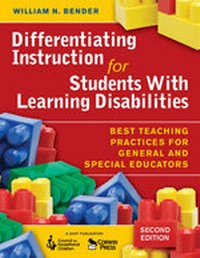
Differentiating Instruction for Students With Learning Disabilities
Best Teaching Practices for General and Special Educators
2nd Edition
Published on 5. September 2007
Book
Paperback/Softback
224 pages
978-1-4129-5446-4 (ISBN)
Description
Written for teachers who want to know how to differentiate instruction for students with learning difficulties, the second edition of Differentiating Instruction for Students with Learning Disabilities draws upon the bestselling success of the first edition in explicitly showing what differentiated instruction is and how to use differentiated strategies in the classroom.
With more concentration on brain-research, multiple intelligence, response to intervention (RTI), tiered instruction, and universal design for learning (UDL), William N. Bender provides the most comprehensive book on differentiated instruction and learning disabilities based on scientific research and with a practical, teacher-friendly approach.
An updated reference section, brief "Teaching Tips" side bars, and thought-provoking new feature "Reflections" augment this powerful resource that educators can immediately use in the classroom with all students who have learning disabilities, who are at-risk, and who may have learning difficulties.
With more concentration on brain-research, multiple intelligence, response to intervention (RTI), tiered instruction, and universal design for learning (UDL), William N. Bender provides the most comprehensive book on differentiated instruction and learning disabilities based on scientific research and with a practical, teacher-friendly approach.
An updated reference section, brief "Teaching Tips" side bars, and thought-provoking new feature "Reflections" augment this powerful resource that educators can immediately use in the classroom with all students who have learning disabilities, who are at-risk, and who may have learning difficulties.
Reviews / Votes
"William Bender has provided a strong basis for developing the understanding of differentiating instruction that can be used by new and experienced teachers in general and special education." -- David M. Sable, Director of Special Education "In light of the rules and changes mandated by No Child Left Behind, the book certainly makes a valuable contribution to the field. NCLB has resulted in ever increasing numbers of students with learning disabilities being educated in the general education classroom. For these students to reach their full potential, teachers must be able to use multiple avenues to reach, teach, and assess students." -- Patricia McCoy DeLancey, Special Educator "The book's format is user-friendly, a definite plus for teachers who are short on time and are looking for ways to enhance their teaching." -- Eloisa E. Alfonso, Exceptional Student Educator "A cornucopia of research-based, teacher-tested strategies that promise to engage students with a wide range of abilities such as we find in today's classrooms. The tips, strategies, and ideas will help teachers solve one of their most perplexing problems: raising the academic performance of students with learning difficulties. This book is a must-have for your teacher toolbox." -- Jim Grant, Executive Director "Both general and special education teachers and college-level collections catering to them will find this second edition essential." -- California Bookwatch, October 2007More details
Edition
2nd Revised edition
Language
English
Place of publication
Thousand Oaks
United States
Publishing group
SAGE Publications Inc
Target group
Professional and scholarly
Edition type
Revised edition
Dimensions
Height: 279 mm
Width: 216 mm
Weight
624 gr
ISBN-13
978-1-4129-5446-4 (9781412954464)
Copyright in bibliographic data and cover images is held by Nielsen Book Services Limited or by the publishers or by their respective licensors: all rights reserved.
Schweitzer Classification
Other editions
New editions
William N. Bender
Differentiating Instruction for Students With Learning Disabilities
New Best Practices for General and Special Educators
Book
10/2012
3rd Edition
Corwin Press Inc
€42.50
Shipment within 10-20 days
Previous edition
William N. Bender
Differentiating Instruction for Students With Learning Disabilities
Best Teaching Practices for General and Special Educators
Book
09/2002
1st Edition
Corwin Press Inc
€48.52
Article exhausted; check for reprint
Person
William N. Bender, PhD, has had a long and distinguished career in education, teaching in public school for several years and in higher education for some 26 years at Blue?eld State College in West Virginia, Rutgers University in New Jersey, and the University of Georgia. He has written 36 books in special and general education. With his retirement, he has stepped back from his rigorous workshop schedule, which as recently as 2016 included some 40 workshop days per year. While the COVID-19 pandemic impacted his work, he has written four historical ?ction novels and several educational books in recent years. He has delivered several professional development projects, including most recently a keynote for a virtual conference on project-based learning in Brazil in conjunction with his Corwin book Project-Based Learning (2012).
Content
About the Author
Acknowledgments
Introduction
1. What Is Differentiated Instruction?
Foundations of Differentiated Instruction
Why Should I Move Into Differentiated Instruction?
Planning a Differentiated Lesson
Several Differentiation Instructional Ideas
What's Next?
2. Universal Design for Differentiation: Organizing the Class for Differentiation and Personal Responsibility for Learning
Universal Design
Structuring the Classroom for Differentiation
A Recommended Room Arrangement Model
Teaching Tactics for Students With Learning Disabilities
The Self-Monitoring Strategy
The Responsibility Strategy
What's Next?
3. Differentiating the Learning Process: Metacognition and Scaffolded Instruction
The Need for Student Support
Scaffolded Instruction
Graphic Organizers
Reconstructive Elaborations
Reciprocal Teaching
Conclusion
What's Next?
4. Learning Strategy Training
Why a Learning Strategy Approach?
What Is a Learning Strategy?
Using Learning Strategies
A Strategy Training Example
Learning Strategies in Math
Developing Your Own Strategies
Conclusion
What's Next?
5. Peer Tutoring in the Inclusive Classroom: Differentiated Instruction and Increasing Instructional Time
Initiating a Peer Tutoring System
Classwide Peer Tutoring (CWPT)
Peer-Assisted Learning Strategies (PALS)
Conclusion
What's Next?
6. Response to Intervention: Performance Monitoring for Differentiating Instruction
Response to Intervention: Monitoring Student Performance
Precision Teaching
Response to Intervention
Assessment Innovations
Assessment Modifications for the Differentiated Class
Conclusion
What's Next?
7. Differentiation in Reading and Literacy Instruction
What Is Literacy Instruction?
Phonological Awareness and Instruction
DIBELS: Measuring Early Literacy
Word Attack and Word Recognition
Vocabulary: Comprehending Words
Reading Fluency
Reading Comprehension Strategies
Conclusion
What's Next?
8. Implementing Differentiated Instruction
Self-Evaluation and Self-Congratulations
A Professional Development Learning Community on Differentiation
Individual Implementation of Differentiation
Conclusion
References
Index
Acknowledgments
Introduction
1. What Is Differentiated Instruction?
Foundations of Differentiated Instruction
Why Should I Move Into Differentiated Instruction?
Planning a Differentiated Lesson
Several Differentiation Instructional Ideas
What's Next?
2. Universal Design for Differentiation: Organizing the Class for Differentiation and Personal Responsibility for Learning
Universal Design
Structuring the Classroom for Differentiation
A Recommended Room Arrangement Model
Teaching Tactics for Students With Learning Disabilities
The Self-Monitoring Strategy
The Responsibility Strategy
What's Next?
3. Differentiating the Learning Process: Metacognition and Scaffolded Instruction
The Need for Student Support
Scaffolded Instruction
Graphic Organizers
Reconstructive Elaborations
Reciprocal Teaching
Conclusion
What's Next?
4. Learning Strategy Training
Why a Learning Strategy Approach?
What Is a Learning Strategy?
Using Learning Strategies
A Strategy Training Example
Learning Strategies in Math
Developing Your Own Strategies
Conclusion
What's Next?
5. Peer Tutoring in the Inclusive Classroom: Differentiated Instruction and Increasing Instructional Time
Initiating a Peer Tutoring System
Classwide Peer Tutoring (CWPT)
Peer-Assisted Learning Strategies (PALS)
Conclusion
What's Next?
6. Response to Intervention: Performance Monitoring for Differentiating Instruction
Response to Intervention: Monitoring Student Performance
Precision Teaching
Response to Intervention
Assessment Innovations
Assessment Modifications for the Differentiated Class
Conclusion
What's Next?
7. Differentiation in Reading and Literacy Instruction
What Is Literacy Instruction?
Phonological Awareness and Instruction
DIBELS: Measuring Early Literacy
Word Attack and Word Recognition
Vocabulary: Comprehending Words
Reading Fluency
Reading Comprehension Strategies
Conclusion
What's Next?
8. Implementing Differentiated Instruction
Self-Evaluation and Self-Congratulations
A Professional Development Learning Community on Differentiation
Individual Implementation of Differentiation
Conclusion
References
Index