

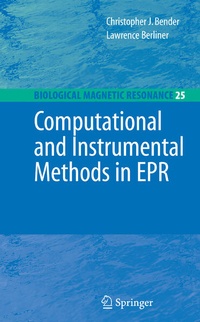
Computational and Instrumental Methods in EPR
Published on 24. November 2010
Book
Paperback/Softback
XIV, 222 pages
978-1-4419-4112-1 (ISBN)
Description
Electron magnetic resonance in the time domain has been greatly facilitated by the introduction of novel resonance structures and better computational tools, such as the increasingly widespread use of density-matrix formalism. This second v- ume in our series, devoted both to instrumentation and computation, addresses - plications and advances in the analysis of spin relaxation time measurements. Chapters 1 deals with the important problem of measuring spin relaxation times over a broad temporal range. The author, Dr. Sushil Misra, has worked on a wide variety of solutions to problems in this area, with respect to both experimental and theoretical aspects, and Chapter 1 summarizes much of his recent work, which was enhanced by a fruitful collaboration with the late Professor Jacques Pescia. Chapter 2 presents solutions to the problem of measuring short spin relaxation times. Again, in collaboration and tribute to the late Jacques Pescia's laboratory, part of the chapter represents a translation of the amplitude modulation technique section from a doctoral thesis by Robert Lopez in 1993 to The Paul Sabatier U- versity. Experimental data that appeared in the original thesis are placed at the end of subsections that correspond to the described technique. Chapter 3 takes up the problem of multi-frequency ENDOR and ESEEM, and illustrates how small stepwise increments of spectrometer operating parameters can enable one to better determine spin-Hamiltonian parameters via a graphical analysis.
More details
Series
Edition
1st ed. Softcover of orig. ed. 2007
Language
English
Place of publication
New York
United States
Target group
Professional and scholarly
Research
Illustrations
XIV, 222 p.
Dimensions
Height: 235 mm
Width: 155 mm
Thickness: 13 mm
Weight
365 gr
ISBN-13
978-1-4419-4112-1 (9781441941121)
DOI
10.1007/978-0-387-38880-9
Schweitzer Classification
Other editions
Additional editions
Christopher J. Bender | Lawrence Berliner
Computational and Instrumental Methods in EPR
Book
10/2006
Springer
€106.99
Shipment within 7-9 days
Persons
Dr. Chris Bender is assistant professor of Chemistry at Fordham University.
Dr. Lawrence J. Berliner is currently Professor and Chair of the Department of Chemistry and Biochemistry at the University of Denver after retiring from Ohio State University, where he spent a 32-year career in the area of biological magnetic resonance (EPR and NMR). He is the Series Editor for Biological Magnetic Resonance, which he launched in 1979.
Dr. Lawrence J. Berliner is currently Professor and Chair of the Department of Chemistry and Biochemistry at the University of Denver after retiring from Ohio State University, where he spent a 32-year career in the area of biological magnetic resonance (EPR and NMR). He is the Series Editor for Biological Magnetic Resonance, which he launched in 1979.
Content
Microwave Amplitude Modulation Technique to Measure Spin-Lattice (T 1) and Spin-Spin (T 2) Relaxation Times.- Improvement in the Measurement of Spin-Lattice Relaxation Time in Electron Paramagnetic Resonance.- Quantitative Measurement of Magnetic Hyperfine Parameters and the Physical Organic Chemistry of Supramolecular Systems.- New Methods of Simulation of Mn(II) EPR Spectra: Single Crystals, Polycrystalline and Amorphous (Biological) Materials.- Density Matrix Formalism of Angular Momentum in Multi-Quantum Magnetic Resonance.