

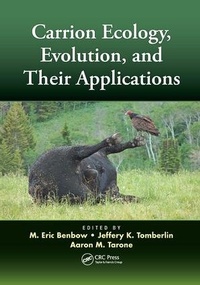
Carrion Ecology, Evolution, and Their Applications
1st Edition
Published on 24. January 2018
Book
Paperback/Softback
608 pages
978-1-138-89384-9 (ISBN)
Description
Shortlisted for the 2018 TWS Wildlife Publication Awards in the edited book category
Decomposition and recycling of vertebrate remains have been understudied, hampered largely due to these processes being aesthetically challenging (e.g., smell and sight). Technological innovations have provided the means to explore new and historically understood natural systems to give us a plethora of new information. Carrion Ecology, Evolution, and Their Applications covers a broad spectrum of topics including the molecular mechanistic foundations that provide the basis for intra- and interspecific interactions related to population biology, community ecology, and how this manifests into habitat- and ecosystem-level importance. The book connects the science of carrion decomposition from genes to ecosystems in multidisciplinary synthesis of the science.
This book brings together a team of global experts involved with measuring and understanding the process and effects of carrion ecology in nature, with special application in such applied fields as forensic entomology, habitat management, animal production (e.g., livestock and aquaculture), and human and environmental health. It fills a large literature gap in ecology, providing a synthesis and future directions important for studies of carrion decomposition that improve the general understanding of decomposition in ecosystems. The book fuses multiple disciplines into a single message explaining the importance of vertebrate carrion ecology in nature.
Illustrates Carrion Decomposition in a 16-Page Color Insert with 40 Photos
The authors illustrate how the study of carrion transcends the globe and expands systems of inquiry, broadening awareness of this important ecosystem process. Whether you are a student, academic, or professional, you will find this book insightful for the fields of molecular ecology, microbiology, entomology, forensics, population biology, community and ecosystem ecology, and human and environmental health.
Decomposition and recycling of vertebrate remains have been understudied, hampered largely due to these processes being aesthetically challenging (e.g., smell and sight). Technological innovations have provided the means to explore new and historically understood natural systems to give us a plethora of new information. Carrion Ecology, Evolution, and Their Applications covers a broad spectrum of topics including the molecular mechanistic foundations that provide the basis for intra- and interspecific interactions related to population biology, community ecology, and how this manifests into habitat- and ecosystem-level importance. The book connects the science of carrion decomposition from genes to ecosystems in multidisciplinary synthesis of the science.
This book brings together a team of global experts involved with measuring and understanding the process and effects of carrion ecology in nature, with special application in such applied fields as forensic entomology, habitat management, animal production (e.g., livestock and aquaculture), and human and environmental health. It fills a large literature gap in ecology, providing a synthesis and future directions important for studies of carrion decomposition that improve the general understanding of decomposition in ecosystems. The book fuses multiple disciplines into a single message explaining the importance of vertebrate carrion ecology in nature.
Illustrates Carrion Decomposition in a 16-Page Color Insert with 40 Photos
The authors illustrate how the study of carrion transcends the globe and expands systems of inquiry, broadening awareness of this important ecosystem process. Whether you are a student, academic, or professional, you will find this book insightful for the fields of molecular ecology, microbiology, entomology, forensics, population biology, community and ecosystem ecology, and human and environmental health.
More details
Language
English
Place of publication
London
United Kingdom
Publishing group
Taylor & Francis Ltd
Target group
Professional and scholarly
Professional Practice & Development
Illustrations
32 farbige Abbildungen, 200 s/w Abbildungen
32 Illustrations, color; 200 Illustrations, black and white
Dimensions
Height: 254 mm
Width: 178 mm
Weight
1120 gr
ISBN-13
978-1-138-89384-9 (9781138893849)
Copyright in bibliographic data and cover images is held by Nielsen Book Services Limited or by the publishers or by their respective licensors: all rights reserved.
Schweitzer Classification
Other editions
Additional editions
M. Eric Benbow | Jeffery K. Tomberlin | Aaron M. Tarone
Carrion Ecology, Evolution, and Their Applications
Book
08/2015
1st Edition
CRC Press
€220.50
Article exhausted; check for reprint
Persons
Dr. M. Eric Benbow is an Assistant Professor in the Departments of Entomology and Osteopathic Medical Specialties at Michigan State University. The research in his lab focuses on microbial-invertebrate community interactions in aquatic ecosystems, disease systems and carrion ecology and evolution. All of these research foci use basic science to inform applications in areas such as human health, natural resources management and forensics. Dr. Benbow has authored or co-authored a collection of over 100 peer-reviewed papers, book chapters, and proceedings, many of which relate to carrion decomposition ecology. He has served on a National Research Council committee related to aquatic ecology, and is regularly invited as a speaker at international and national academic meetings related to aquatic, disease and decomposition ecology. Dr. Benbow has led workshops at the international level discussing experimental design, statistical analyses and the importance of novel basic ecological concepts in advancing the field of carrion ecology and applications in forensics. Dr. Benbow was part of the inaugural executive committee for the North American Forensic Entomology Association (NAFEA) where he served as the Editor-in-Chief of the annual NAFEA Newsletter and NAFEA Webmaster (www.nafea.net) for eight years. He was the president of NAFEA from 2012-2013 and has served as an expert witness and worked on several cases that involved insects as evidence during investigations or water resource litigation. He continues a recognized research program in microbe-insect interactions that supports undergraduate and graduate students and postdoctoral associates. Dr. Benbow continues to mentor and co-mentor students and postdoctoral associates through research and teaching. He sees the future of ecology and evolution to fundamentally be in the hands of students and early scientists worldwide.
Dr. Jeffery K. Tomberlin is an associate professor and c
Dr. Jeffery K. Tomberlin is an associate professor and c
Content
Introduction. Ecological Mechanisms of Carrion Decomposition. Evolutionary Ecology of Carrion Decomposition. Applications of Carrion Decomposition.