

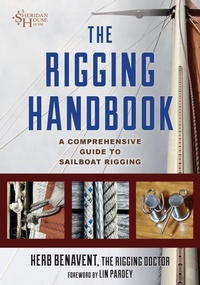
The Rigging Handbook
A Comprehensive Guide to Sailboat Rigging
Will be published approx. on 4. November 2025
Book
Paperback/Softback
256 pages
978-1-4930-8600-9 (ISBN)
Description
From YouTube's popular Rigging Doctor channel, The Rigging Handbook is an introductory to mid-level book intended for boat owners, sailors, and cruisers who want to better understand how the mast and sails work.
Part I covers the function of rigging on a sailboat and a general overview of common rig designs-with a focus on single-masted sloops and cutters, and two-masted ketches, yawls, and schooners-as well as the slight nuances between them. Chapters then progress to introducing the parts of standing rigging (the parts that hold the mast up) and running rigging (parts that hold the sails); the function of each piece; and a discussion of the strengths and weaknesses of all rigging materials, including hemp, galvanized steel, stainless steel, titanium and aluminum, and Dyneema (synthetic).
Part II discusses how to evaluate, tune, repair, and replace rigging. Chapters cover in detail what happens when rigging parts fail or reach the end of their serviceable life-including from corrosion, cracks, and UV damage-how to perform a rig survey, and considerations for the wear and tear that happens with time, distance, and use and abuse. The final chapters discuss the basics of replacing standing and running rigging-including set up and tuning-and the advantages of steel versus synthetic, and polyester versus more modern fibers, enabling the reader to make an informed decision as to what grade of equipment they wish to use to outfit their boat.
Part I covers the function of rigging on a sailboat and a general overview of common rig designs-with a focus on single-masted sloops and cutters, and two-masted ketches, yawls, and schooners-as well as the slight nuances between them. Chapters then progress to introducing the parts of standing rigging (the parts that hold the mast up) and running rigging (parts that hold the sails); the function of each piece; and a discussion of the strengths and weaknesses of all rigging materials, including hemp, galvanized steel, stainless steel, titanium and aluminum, and Dyneema (synthetic).
Part II discusses how to evaluate, tune, repair, and replace rigging. Chapters cover in detail what happens when rigging parts fail or reach the end of their serviceable life-including from corrosion, cracks, and UV damage-how to perform a rig survey, and considerations for the wear and tear that happens with time, distance, and use and abuse. The final chapters discuss the basics of replacing standing and running rigging-including set up and tuning-and the advantages of steel versus synthetic, and polyester versus more modern fibers, enabling the reader to make an informed decision as to what grade of equipment they wish to use to outfit their boat.
Reviews / Votes
"Highly useful and interesting." -- Lin Pardey, voyager, US Sailing Hall of Fame inductee, and author of twelve books on cruising and seamanship, including Storm Tactics Handbook "Brian Toss taught us to respect the rig. Herb Benavent picks up the thread with modern clarity and a DIY sailor's voice. If you want to understand, inspect, and maintain your own rig-with today's tools, materials, and realities-this is the book to have aboard. Practical, current, and confidently hands-on."-- James Evenson, Sailing Zingaro; author of Be The Captain "This book is essential for anyone thinking about sailing in the modern world. Herby is a rare and refreshing talent, someone who embraces new ideas and materials. He will take the best of the old wisdom and add to it with his own thoughts and findings. Herby is not just a theorist; all his ideas are utilised on his own boats, which he will then sail across an ocean to test. The world could do with more sailors like him." -- Steve Holloway, Sailing Fair Isle
More details
Series
Language
English
Place of publication
Guilford
United States
Publishing group
Rowman & Littlefield
Product notice
Paperback (trade)
Illustrations
Illustrations; Halftones, Black & White including Black & White Photographs; Black & White Illustrations
Dimensions
Height: 177 mm
Width: 255 mm
Thickness: 21 mm
Weight
610 gr
ISBN-13
978-1-4930-8600-9 (9781493086009)
Copyright in bibliographic data and cover images is held by Nielsen Book Services Limited or by the publishers or by their respective licensors: all rights reserved.
Schweitzer Classification
Other editions
Additional editions
E-Book
03/2026
The Lyons Press
€28.67
Available for download
Person
Herb Benavent, the Rigging Doctor, has been living the cruising life since 2017 when he and his wife, Maddie, left Baltimore, MD and set off to do the impossible: cruise full time in a 1968 Morgan 45 with an electric motor and synthetic rigging, showing how it can be done to allow you to sail sustainably as far as your heart desires! Some 18,000 nautical miles later, they have sailed to the Bahamas, Bermuda, the Azores, Portugal, Spain, Gibraltar, Morocco, Madeira, Cape Verde, Suriname, USVI, and Puerto Rico.
Currently, Herb and Maddie are back living in Baltimore as they refit a 1966 Alberg 30 into a proper cruising yacht.
Currently, Herb and Maddie are back living in Baltimore as they refit a 1966 Alberg 30 into a proper cruising yacht.
Content
Introduction
Part I: Foundations of Rigging
Chapter 1: Looking Up
Chapter 2: Setting Sail
Chapter 3: Rigging It
Chapter 4: The Mast Itself
Chapter 5: How Running Rigging Ties In
Chapter 6: How Sails make it all work
Chapter 7: Going to the Top
Chapter 8: Down to the Bottom
Chapter 9: Rigging Materials
Chapter 10: Building It
Part II: Mechanics of Rigging
Chapter 11: When Things Go Wrong
Chapter 12: How to Carry Out a Rig Inspection
Chapter 13: When To Replace
Chapter 14: Avoid Repeating Your Mistakes
Chapter 15: Steel versus Synthetic
Chapter 16: A Frayed Knot
Chapter 17: Setting Up the Standing Rigging
Chapter 18: Setting Up the Running Rigging
Chapter 19: Tune Your Sailboat
Afterword
Glossary
Index
Part I: Foundations of Rigging
Chapter 1: Looking Up
Chapter 2: Setting Sail
Chapter 3: Rigging It
Chapter 4: The Mast Itself
Chapter 5: How Running Rigging Ties In
Chapter 6: How Sails make it all work
Chapter 7: Going to the Top
Chapter 8: Down to the Bottom
Chapter 9: Rigging Materials
Chapter 10: Building It
Part II: Mechanics of Rigging
Chapter 11: When Things Go Wrong
Chapter 12: How to Carry Out a Rig Inspection
Chapter 13: When To Replace
Chapter 14: Avoid Repeating Your Mistakes
Chapter 15: Steel versus Synthetic
Chapter 16: A Frayed Knot
Chapter 17: Setting Up the Standing Rigging
Chapter 18: Setting Up the Running Rigging
Chapter 19: Tune Your Sailboat
Afterword
Glossary
Index