

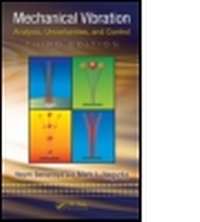
Mechanical Vibration
Analysis, Uncertainties, and Control, Third Edition
3rd Edition
Published on 1. June 2009
Book
Hardback
992 pages
978-1-4200-8056-8 (ISBN)
Description
Mechanical Vibration: Analysis, Uncertainties, and Control simply and comprehensively addresses the fundamental principles of vibration theory, emphasizing its application in solving practical engineering problems. The authors focus on strengthening engineers' command of mathematics as a cornerstone for understanding vibration, control, and the ways in which uncertainties affect analysis. It provides a detailed exploration and explanation of the essential equations involved in modeling vibrating systems and shows readers how to employ MATLAB (R) as an advanced tool for analyzing specific problems.
Forgoing the extensive and in-depth analysis of randomness and control found in more specialized texts, this straightforward, easy-to-follow volume presents the format, content, and depth of description that the authors themselves would have found useful when they first learned the subject. The authors assume that the readers have a basic knowledge of dynamics, mechanics of materials, differential equations, and some knowledge of matrix algebra. Clarifying necessary mathematics, they present formulations and explanations to convey significant details.
The material is organized to afford great flexibility regarding course level, content, and usefulness in self-study for practicing engineers or as a text for graduate engineering students. This work includes example problems and explanatory figures, biographies of renowned contributors, and access to a website providing supplementary resources. These include an online MATLAB primer featuring original programs that can be used to solve complex problems and test solutions.
Forgoing the extensive and in-depth analysis of randomness and control found in more specialized texts, this straightforward, easy-to-follow volume presents the format, content, and depth of description that the authors themselves would have found useful when they first learned the subject. The authors assume that the readers have a basic knowledge of dynamics, mechanics of materials, differential equations, and some knowledge of matrix algebra. Clarifying necessary mathematics, they present formulations and explanations to convey significant details.
The material is organized to afford great flexibility regarding course level, content, and usefulness in self-study for practicing engineers or as a text for graduate engineering students. This work includes example problems and explanatory figures, biographies of renowned contributors, and access to a website providing supplementary resources. These include an online MATLAB primer featuring original programs that can be used to solve complex problems and test solutions.
Reviews / Votes
"... this book stands out in a number of ways. ... the book is more enjoyable to read than most. It contains numerous biographical summaries of the lives and achievements of famous people in the field, footnotes providing background information, sometimes from quite diverse branches of science, and material describing the practical problems faced by the engineer, with descriptions and pictures of applications. All these make the text readable. Finally the prose is written in a somewhat informal and often amusing style, in the first person, which also improves its readability, although perhaps a bit verbose in places."--Professor B. Mace, Professor of Structural Dynamics, University of Southampton, THE AERONAUTICAL JOURNAL FEBRUARY 2012
More details
Series
Edition
3rd New edition
Language
English
Place of publication
Bosa Roca
United States
Publishing group
Taylor & Francis Inc
Target group
College/higher education
Senior undergraduates and graduate students in mechanical engineering.
Edition type
New edition
Product notice
Paper over boards
Illustrations
419 s/w Abbildungen, 10 s/w Tabellen
800-900 equations; 10 Tables, black and white; 419 Illustrations, black and white
Dimensions
Height: 235 mm
Width: 156 mm
Weight
1769 gr
ISBN-13
978-1-4200-8056-8 (9781420080568)
Copyright in bibliographic data and cover images is held by Nielsen Book Services Limited or by the publishers or by their respective licensors: all rights reserved.
Schweitzer Classification
Other editions
New editions
Haym Benaroya | Mark Nagurka | Seon Han
Mechanical Vibration
Analysis, Uncertainties, and Control, Fourth Edition
Book
10/2017
4th Edition
CRC Press
Unfortunately, price unknown
Article exhausted; check different version
Additional editions
Haym Benaroya | Mark Nagurka
Mechanical Vibration
Analysis, Uncertainties, and Control, Third Edition
E-Book
06/2009
3rd Edition
CRC Press
€51.99
Available for download
Previous edition

Book
10/2004
2nd Edition
Marcel Dekker Inc
€114.08
Article exhausted; check for reprint
Persons
Rutgers University, Piscataway, New Jersey, USA Marquette University, Milwaukee, Wisconsin, USA
Content
Introduction and Background
Basic Concepts of Systems and Structures
Basic Concepts of Vibration
Basic Concepts of Random Vibration
Types of System Models
Basic Dynamics
Units
Concluding Summary
Single Degree-of-Freedom Vibration: Discrete Models
Motivating Examples
Mathematical Modeling: Deterministic
Undamped Free Vibration
Harmonic Forcing with no Damping
Concepts Summary
Single Degree-of-Freedom Vibration: Discrete Models with Damping
Damping
Free Vibration with Viscous Damping
Free Response with Coulomb Damping
Forced Vibration with Viscous Damping
Forced Harmonic Vibration
Periodic but Not Harmonic Excitation
Concepts Summary
Single Degree-of-Freedom Vibration: General Loading and Advanced Topics
Arbitrary Loading: Laplace Transform
Step Loading
Impulsive Excitation
Arbitrary Loading
Introduction to Lagrange.s Equation
Notions of Randomness
Notions of Control
The Inverse Problem
A Self-Excited System and its Stability
Solution Analysis and Design Techniques
A Model of a Bouncing Ball
Concepts Summary
Single Degree-of-Freedom Vibration: Probabilistic Forces
Introduction
Example Problems and Motivation
Random Variables
Mathematical Expectation
Useful Probability Densities
Two Random Variables
Random Processes
Random Vibration
Concepts Summary
Vibration Control
Motivation
Approaches to Controlling Vibration
Feedback Control
Performance of Feedback Control Systems
Control of Response
Sensitivity to Parameter Variations
State Variable Models
Concepts Summary
Variational Principles and Analytical Dynamics
Introduction
Virtual Work
Lagrange.s Equation of Motion
Hamilton's Principle
Lagrange's Equation with Damping
Concepts Summary
Multi Degree-of-Freedom Vibration: Introductory Topics
Example Problems and Motivation
The Concepts of Sti?ness and Flexibility
Derivation of Equations of Motion
Undamped Vibration
Direct Method: Free Vibration with Damping
Modal Analysis
Real and Complex Modes
Concepts Summary
Multi Degree-of-Freedom Vibration: Advanced Topics
Overview
Unrestrained Systems
The Geometry of the Eigenvalue Problem
Periodic Structures
Inverse Vibration
Sloshing of Fluids in Containers
Stability of Motion
Multivariable Control
MDOF Stochastic Response
Stochastic Control
Rayleigh.s Quotient
Monte Carlo Simulation
Concepts Summary
Continuous Models for Vibration
Continuous Limit of a Discrete Formulation
Vibration of String
Longitudinal (Axial) Vibration of Beams
Torsional Vibration of Shafts
10.5 Transverse Vibration of Beams
10.6 Beam Vibration: Special Problems
Concepts Summary
Continuous Models for Vibration: Advanced Models
Vibration of Membranes
Vibration of Plates
Random Vibration of Continuous Structures
Approximate Methods
Variables That Do Not Separate
Concepts Summary
Nonlinear Vibration
Examples of Nonlinear Vibration
The Phase Plane
Perturbation Methods
The Mathieu Equation
The van der Pol Equation
Motion in the Large
Nonlinear Control
Advanced Topics
Concluding Summary
Appendices
A Mathematical Concepts for Vibration
Complex Numbers
Matrices
Taylor Series and Linearization
Ordinary Di?erential Equations
Laplace Transforms
Fourier Series and Transforms
Partial Di?erential Equations
Index
Basic Concepts of Systems and Structures
Basic Concepts of Vibration
Basic Concepts of Random Vibration
Types of System Models
Basic Dynamics
Units
Concluding Summary
Single Degree-of-Freedom Vibration: Discrete Models
Motivating Examples
Mathematical Modeling: Deterministic
Undamped Free Vibration
Harmonic Forcing with no Damping
Concepts Summary
Single Degree-of-Freedom Vibration: Discrete Models with Damping
Damping
Free Vibration with Viscous Damping
Free Response with Coulomb Damping
Forced Vibration with Viscous Damping
Forced Harmonic Vibration
Periodic but Not Harmonic Excitation
Concepts Summary
Single Degree-of-Freedom Vibration: General Loading and Advanced Topics
Arbitrary Loading: Laplace Transform
Step Loading
Impulsive Excitation
Arbitrary Loading
Introduction to Lagrange.s Equation
Notions of Randomness
Notions of Control
The Inverse Problem
A Self-Excited System and its Stability
Solution Analysis and Design Techniques
A Model of a Bouncing Ball
Concepts Summary
Single Degree-of-Freedom Vibration: Probabilistic Forces
Introduction
Example Problems and Motivation
Random Variables
Mathematical Expectation
Useful Probability Densities
Two Random Variables
Random Processes
Random Vibration
Concepts Summary
Vibration Control
Motivation
Approaches to Controlling Vibration
Feedback Control
Performance of Feedback Control Systems
Control of Response
Sensitivity to Parameter Variations
State Variable Models
Concepts Summary
Variational Principles and Analytical Dynamics
Introduction
Virtual Work
Lagrange.s Equation of Motion
Hamilton's Principle
Lagrange's Equation with Damping
Concepts Summary
Multi Degree-of-Freedom Vibration: Introductory Topics
Example Problems and Motivation
The Concepts of Sti?ness and Flexibility
Derivation of Equations of Motion
Undamped Vibration
Direct Method: Free Vibration with Damping
Modal Analysis
Real and Complex Modes
Concepts Summary
Multi Degree-of-Freedom Vibration: Advanced Topics
Overview
Unrestrained Systems
The Geometry of the Eigenvalue Problem
Periodic Structures
Inverse Vibration
Sloshing of Fluids in Containers
Stability of Motion
Multivariable Control
MDOF Stochastic Response
Stochastic Control
Rayleigh.s Quotient
Monte Carlo Simulation
Concepts Summary
Continuous Models for Vibration
Continuous Limit of a Discrete Formulation
Vibration of String
Longitudinal (Axial) Vibration of Beams
Torsional Vibration of Shafts
10.5 Transverse Vibration of Beams
10.6 Beam Vibration: Special Problems
Concepts Summary
Continuous Models for Vibration: Advanced Models
Vibration of Membranes
Vibration of Plates
Random Vibration of Continuous Structures
Approximate Methods
Variables That Do Not Separate
Concepts Summary
Nonlinear Vibration
Examples of Nonlinear Vibration
The Phase Plane
Perturbation Methods
The Mathieu Equation
The van der Pol Equation
Motion in the Large
Nonlinear Control
Advanced Topics
Concluding Summary
Appendices
A Mathematical Concepts for Vibration
Complex Numbers
Matrices
Taylor Series and Linearization
Ordinary Di?erential Equations
Laplace Transforms
Fourier Series and Transforms
Partial Di?erential Equations
Index