

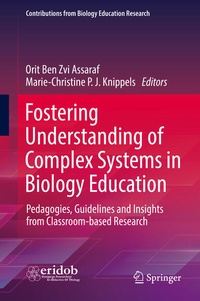
Fostering Understanding of Complex Systems in Biology Education
Pedagogies, Guidelines and Insights from Classroom-based Research
Published on 26. May 2022
Book
Hardback
VIII, 278 pages
978-3-030-98143-3 (ISBN)
Description
Prof. Orit Ben-Zvi Assaraf is former Chair of the Graduate Program for Science and Technology Education, at the Ben-Gurion University of the Negev Israel. Her work in science education focuses on issues such as: Design of informal outdoor learning environments; Cognitive based research into systems thinking in the ?eld of Biology, Ecology and Earth sciences and development of environmental literacy and nature conservation within science education.
More details
Series
Edition
2022 ed.
Language
English
Place of publication
Cham
Switzerland
Publishing group
Springer International Publishing
Target group
Professional and scholarly
Illustrations
1 s/w Abbildung
VIII, 278 p. 1 illus.
Dimensions
Height: 241 mm
Width: 160 mm
Thickness: 22 mm
Weight
600 gr
ISBN-13
978-3-030-98143-3 (9783030981433)
DOI
10.1007/978-3-030-98144-0
Schweitzer Classification
Other editions
Additional editions
Orit Ben Zvi Assaraf | Marie-Christine P. J. Knippels
Fostering Understanding of Complex Systems in Biology Education
Pedagogies, Guidelines and Insights from Classroom-based Research
Book
05/2023
Springer
€149.79
Shipment within 7-9 days
Orit Ben Zvi Assaraf | Marie-Christine P. J. Knippels
Fostering Understanding of Complex Systems in Biology Education
Pedagogies, Guidelines and Insights from Classroom-based Research
E-Book
05/2022
1st Edition
Springer
€139.09
Available for download
Persons
Prof. Orit Ben-Zvi Assaraf is former Chair of the Graduate Program for Science and Technology Education, at the Ben-Gurion University of the Negev Israel. Her work in science education focuses on issues such as: Design of informal outdoor learning environments; Cognitive based research into systems thinking in the ?eld of Biology, Ecology and Earth sciences and development of environmental literacy and nature conservation within science education.
Dr. Marie-Christine Knippels is an Associate Professor in Science Education and former head of the Biology education team at the Freudenthal Institute, Utrecht University, the Netherlands. She is a biologist, holds a PhD in Genetics Education and completed a postdoc research project on moral reasoning in genomics-related dilemmas. Her research focuses on fostering metacognitive skills in biology education and promoting scientific literacy and citizenship, through design based research and Lesson study projects. She has (co)authoredarticles on 'yo-yo thinking', systems thinking, reasoning with models in biology education and socio-scientific issues. She has been involved in various European projects and networks, and led the EU-FP7 PARRISE project.
Dr. Marie-Christine Knippels is an Associate Professor in Science Education and former head of the Biology education team at the Freudenthal Institute, Utrecht University, the Netherlands. She is a biologist, holds a PhD in Genetics Education and completed a postdoc research project on moral reasoning in genomics-related dilemmas. Her research focuses on fostering metacognitive skills in biology education and promoting scientific literacy and citizenship, through design based research and Lesson study projects. She has (co)authoredarticles on 'yo-yo thinking', systems thinking, reasoning with models in biology education and socio-scientific issues. She has been involved in various European projects and networks, and led the EU-FP7 PARRISE project.
Content
1. Theoretical Perspectives on Complex Systems in Biology Education.- 2. Long Term Ecological Research as a Learning Environment: Evaluating Its Impact in Developing the Understanding of Ecological Systems Thinking - A Case Study.- 3. Involving teachers in the design process of a teaching and learning trajectory to foster students' systems thinking.- 4. Supporting university student learning of complex systems: an example of teaching the interactive processes that constitute photosynthesis.- 5. High school students' causal reasoning and molecular mechanistic reasoning about gene-environment interplay after a semester-long course in genetics.- 6. Systems Thinking in Ecological and Physiological Systems and the Role of Representations.- 7. The Zoom-Map-Explaining Complex Biological Phenomena by Drawing Connections between and in Levels of Organization.- 8. Pre-service teachers' coual schemata and system reasoning about the carbon cycle and climate change: an exploratory study of a learning framework for understanding complex systems.- 9. Teaching Students to Grasp Complexity in Biology Education using a "Body of Evidence" Approach.- 10. Science teachers' construction of knowledge about simulations and population size via performing inquiry with simulations of growing vs. descending levels of complexity.- 11. Designing Complex Systems Curricula for High School Biology: A Decade of work with the BioGraph Project.- 12. Lessons learned: Synthesizing approaches that foster understanding of complex biological phenomena.