


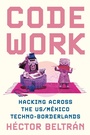
Code Work
Hacking across the US/Mexico Techno-Borderlands
Published on 14. November 2023
Book
Hardback
240 pages
978-0-691-24503-4 (ISBN)
Description
How Mexican and Latinx hackers apply concepts from coding to their lived experiences
In Code Work, Hector Beltran examines Mexican and Latinx coders' personal strategies of self-making as they navigate a transnational economy of tech work. Beltran shows how these hackers apply concepts from the code worlds to their lived experiences, deploying batches, loose coupling, iterative processing (looping), hacking, prototyping, and full-stack development in their daily social interactions-at home, in the workplace, on the dating scene, and in their understanding of the economy, culture, and geopolitics. Merging ethnographic analysis with systems thinking, he draws on his eight years of research in Mexico and the United States-during which he participated in and observed hackathons, hacker schools, and tech entrepreneurship conferences-to unpack the conundrums faced by workers in a tech economy that stretches from villages in rural Mexico to Silicon Valley.
Beltran chronicles the tension between the transformative promise of hacking-the idea that coding will reconfigure the boundaries of race, ethnicity, class, and gender-and the reality of a neoliberal capitalist economy divided and structured by the US/Mexico border. Young hackers, many of whom approach coding in a spirit of playfulness and exploration, are encouraged to appropriate the discourses of flexibility and self-management even as they remain outside formal employment. Beltran explores the ways that "innovative culture" is seen as central in curing Mexico's social ills, showing that when innovation is linked to technological development, other kinds of development are neglected. Beltran's highly original, wide-ranging analysis uniquely connects technology studies, the anthropology of capitalism, and Latinx and Latin American studies.
In Code Work, Hector Beltran examines Mexican and Latinx coders' personal strategies of self-making as they navigate a transnational economy of tech work. Beltran shows how these hackers apply concepts from the code worlds to their lived experiences, deploying batches, loose coupling, iterative processing (looping), hacking, prototyping, and full-stack development in their daily social interactions-at home, in the workplace, on the dating scene, and in their understanding of the economy, culture, and geopolitics. Merging ethnographic analysis with systems thinking, he draws on his eight years of research in Mexico and the United States-during which he participated in and observed hackathons, hacker schools, and tech entrepreneurship conferences-to unpack the conundrums faced by workers in a tech economy that stretches from villages in rural Mexico to Silicon Valley.
Beltran chronicles the tension between the transformative promise of hacking-the idea that coding will reconfigure the boundaries of race, ethnicity, class, and gender-and the reality of a neoliberal capitalist economy divided and structured by the US/Mexico border. Young hackers, many of whom approach coding in a spirit of playfulness and exploration, are encouraged to appropriate the discourses of flexibility and self-management even as they remain outside formal employment. Beltran explores the ways that "innovative culture" is seen as central in curing Mexico's social ills, showing that when innovation is linked to technological development, other kinds of development are neglected. Beltran's highly original, wide-ranging analysis uniquely connects technology studies, the anthropology of capitalism, and Latinx and Latin American studies.
Reviews / Votes
"Winner of the Labor Tech Book Award, Labor Tech Research Network" "Winner of the Association of Latina/o and Latinx Anthropologists Book Award" "Honorable Mention for the Arthur J. Rubel Book Prize, Society for Latin American and Caribbean Anthropology" "Winner of the Americo Paredes Book Award, South Texas College" "Winner of the Society for Anthropology of Work Book Award"More details
Series
Language
English
Place of publication
New Jersey
United States
Product notice
Trade binding
Illustrations
7 b/w illus.
Dimensions
Height: 235 mm
Width: 156 mm
ISBN-13
978-0-691-24503-4 (9780691245034)
Copyright in bibliographic data and cover images is held by Nielsen Book Services Limited or by the publishers or by their respective licensors: all rights reserved.
Schweitzer Classification
Other editions
Additional editions
E-Book
11/2023
1st Edition
Princeton University Press
€26.49
Available for download
Person
Hector Beltran is assistant professor of anthropology at the Massachusetts Institute of Technology.