

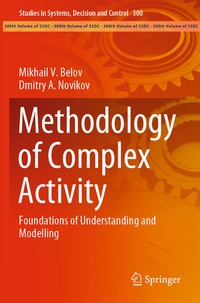
Methodology of Complex Activity
Foundations of Understanding and Modelling
Published on 1. July 2021
Book
Paperback/Softback
XIV, 223 pages
978-3-030-48612-9 (ISBN)
Description
This book develops and describes a general methodology that can be applied to any complex human activity (activity with a non-trivial, multi-level internal structure).
The structural components of complex activities are considered, and their logical, cause-and-effect, and process structures are functionally described. Considerable attention is paid to organization and management, uncertainties, and the lifecycles of activities, as well as the actors, subject matter, resources, knowledge, and methods involved.
Several typical examples are used throughout the text to illustrate the implementation of common approaches involving the functioning of work groups, organizational units, projects, and organizations in general: a retail bank, an aircraft manufacturer, a fire department, and a nuclear power plant. In addition, the book employs a system of connected technical models, in order to ensure that the results are of practical applicability for both experts on the ground and scholars engaged in research on the general principles of how activities (practical, scientific, etc.) are organized or on the management of socio-technical systems.More details
Series
Edition
2020 ed.
Language
English
Place of publication
Cham
Switzerland
Publishing group
Springer International Publishing
Target group
Professional and scholarly
Illustrations
61 s/w Abbildungen, 9 farbige Abbildungen
XIV, 223 p. 70 illus., 9 illus. in color.
Dimensions
Height: 235 mm
Width: 155 mm
Thickness: 14 mm
Weight
371 gr
ISBN-13
978-3-030-48612-9 (9783030486129)
DOI
10.1007/978-3-030-48610-5
Schweitzer Classification
Other editions
Additional editions

Mikhail V. Belov | Dmitry A. Novikov
Methodology of Complex Activity
Foundations of Understanding and Modelling
Book
07/2020
Springer
€106.99
Shipment within 7-9 days
Content
Formulation of Problems and General Approaches.- Complex Activity and its System-Wide Character.- Structural Models of Complex Activity.- Uncertainty and Creation of Complex Activity Components.- Process Models of Complex Activity.- Effectiveness and Efficiency of Complex Activity.- Organization and Management of Complex Activity.