

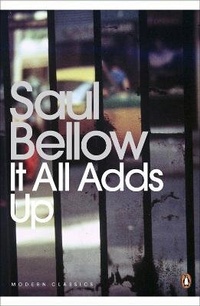
It All Adds Up
Published on 25. October 2007
Book
Paperback/Softback
352 pages
978-0-14-118882-9 (ISBN)
Description
Bellow was America's writer, and in this superb collection of nonfiction essays he demonstated his vigilance of and loyalty to his country over a span of 45 years. From his earliest piece, a war report from Spain written for the Partisan Review (1948), to his Novel Prize lecture (1976), to a Forbes article entitled "There Is Simply Too Much To Think About," Bellow was consumed by the idea of America--so great, so accomplished, so magical--destroying its soul.
More details
Series
Language
English
Place of publication
London
United Kingdom
Publishing group
Penguin Books Ltd
Product notice
Paperback (UK-B)
Dimensions
Height: 199 mm
Width: 133 mm
Thickness: 22 mm
Weight
258 gr
ISBN-13
978-0-14-118882-9 (9780141188829)
Copyright in bibliographic data and cover images is held by Nielsen Book Services Limited or by the publishers or by their respective licensors: all rights reserved.
Schweitzer Classification
Other editions
Additional editions
Person
Saul Bellow was born in 1915 to Russian emigre parents. As a young child in Chicago, Bellow was raised on books - the Old Testament, Shakespeare, Tolstoy and Chekhov - and learned Hebrew and Yiddish. He set his heart on becoming a writer after reading Uncle Tom's Cabin, contrary to his mother's hopes that he would become a rabbi or a concert violinist. He was educated at the University of Chicago and North-Western University, graduating in Anthropology and Sociology; he then went on to work for the Encyclopaedia Britannica.
Bellow published his first novel, The Dangling Man, in 1944; this was followed, in 1947, by The Victim. In 1948 a Guggenheim Fellowship enabled Bellow to travel to Paris, where he wrote The Adventures of Augie March, published in 1953. Henderson The Rain King (1959) brought Bellow worldwide fame, and in 1964, his best-known novel, Herzog, was published and immediately lauded as a masterpiece, 'a well-nigh faultless novel' (New Yorker).
Saul Bellow's dazzling career as a novelist was celebrated during his lifetime with an unprecedented array of literary prizes and awards, including the Pulitzer Prize, three National Book Awards, and the Gold Medal for the Novel. In 1976 he was awarded a Nobel Prize 'for the human understanding and subtle analysis of contemporary culture that are combined in his work'.
Bellow's death in 2005 was met with tribute from writers and critics around the world, including James Wood, who praised 'the beauty of this writing, its music, its high lyricism, its firm but luxurious pleasure in language itself'.
Bellow published his first novel, The Dangling Man, in 1944; this was followed, in 1947, by The Victim. In 1948 a Guggenheim Fellowship enabled Bellow to travel to Paris, where he wrote The Adventures of Augie March, published in 1953. Henderson The Rain King (1959) brought Bellow worldwide fame, and in 1964, his best-known novel, Herzog, was published and immediately lauded as a masterpiece, 'a well-nigh faultless novel' (New Yorker).
Saul Bellow's dazzling career as a novelist was celebrated during his lifetime with an unprecedented array of literary prizes and awards, including the Pulitzer Prize, three National Book Awards, and the Gold Medal for the Novel. In 1976 he was awarded a Nobel Prize 'for the human understanding and subtle analysis of contemporary culture that are combined in his work'.
Bellow's death in 2005 was met with tribute from writers and critics around the world, including James Wood, who praised 'the beauty of this writing, its music, its high lyricism, its firm but luxurious pleasure in language itself'.