

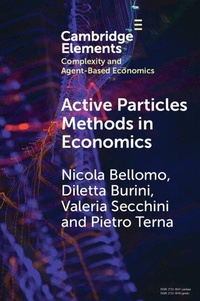
Active Particles Methods in Economics
New Perspectives in the Interaction between Mathematics and Economics
Published on 2. January 2025
Book
Paperback/Softback
64 pages
978-1-009-54876-2 (ISBN)
Description
The aim of this Element is to understand how far mathematical theories based on active particles methods have been applied to describe the dynamics of complex systems in economics, and to look forward to further research perspectives in the interaction between mathematics and economics. The mathematical theory of active particles and the theory of behavioral swarms are selected for the above interaction. The mathematical approach considered in this work takes into account the complexity of living systems, which is a key feature of behavioral economics. The modeling and simulation of the dynamics of prices within a heterogeneous population is reviewed to show how mathematical tools can be used in real applications.
More details
Series
Language
English
Place of publication
Cambridge
United Kingdom
Product notice
Paperback (trade)
Illustrations
Worked examples or Exercises
Dimensions
Height: 229 mm
Width: 152 mm
Thickness: 4 mm
Weight
108 gr
ISBN-13
978-1-009-54876-2 (9781009548762)
Copyright in bibliographic data and cover images is held by Nielsen Book Services Limited or by the publishers or by their respective licensors: all rights reserved.
Schweitzer Classification
Other editions
Additional editions
Nicola Bellomo | Diletta Burini | Valeria Secchini
Active Particles Methods in Economics
New Perspectives in the Interaction between Mathematics and Economics
Book
01/2025
Cambridge University Press
€75.10
Shipment within 15-20 days
Persons
Content
1. Aims and Plan of this Element; 2. On a quest towards a mathematical theory of living systems; 3. A handbook of mathematical tools; 4. On price dynamics in heterogeneous Societies; 5. Further developments of mathematical theory; 6. On a forward look to research challenges; 7. The computational code; 8. Closure: On the role of hard sciences in economic theories; References.