

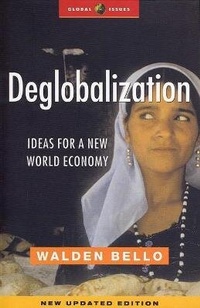
Deglobalization
Ideas for a New World Economy
Published on 30. October 2002
Book
Paperback/Softback
160 pages
978-1-84277-305-5 (ISBN)
Description
How to manage the global economy - and, more fundamentally, whether humanity wishes it to go in an ever more market-oriented, transnational corporation-dominated, and capital-footloose direction - is the most important international question of our time. In this short and trenchant history of those bodies -- the World Bank, IMF, WTO, and Group of Seven -- which have promoted this economic globalization, Walden Bello:
* Points to their manifest failings;
* Examines the major new ideas put forward for reforming the management of the world economy;
* Argues for a much more fundamental shift towards a decentralized, pluralistic system of global economic governance allowing countries to follow development strategies sensitive to their own values and particular mix of constraints and opportunities.
* Points to their manifest failings;
* Examines the major new ideas put forward for reforming the management of the world economy;
* Argues for a much more fundamental shift towards a decentralized, pluralistic system of global economic governance allowing countries to follow development strategies sensitive to their own values and particular mix of constraints and opportunities.
Reviews / Votes
'Clear analysis and impressive scholarship have made Bello one of Asia's key progressive thinkers. Insistence on people-centered development grounded in ecological sustainability sets him apart from the elite consensus on Asia'New Internationalist
'The most respected anti-globalization thinker in Asia'
Le Soir (Belgium)
'Among the expanding constellation of activists, academicians, and thinkers who believe that mainstream economics... does not have an answer to people's needs, Walden Bello is a prominent star'
Bangkok Post
'Whatever subject he tackles, Walden Bello is always thoughtful,
trenchant and constructive. He's also an authentic hero of the global justice movement.'
Susan George
'Walden Bello is the world's leading no-nonsense revolutionary. With plainspoken history and compelling evidence, he ruthlessly exposes the opportunism, plunder, and backroom bullying that passes for global capitalism. But this is more than a critique: Bello's expert diagnosis is that the patient is sicker than we think, and the time to act is now.'
Naomi Klein, author, No Logo
'De-Globalization is a superb dissection of contemporary capitalism's multiple crises, a powerful indictment of the US's brutal re-subordination of the global South in the interest of its MNCs and banks, an unanswerable demonstration of the unreformability of the IMF and its sister institutions, and a stirring call to arms for the movement for economic justice by one of its major theorists and organizers.'
Robert Brenner
More details
Series
Language
English
Place of publication
United Kingdom
Publishing group
Bloomsbury Publishing PLC
Target group
College/higher education
Professional and scholarly
ISBN-13
978-1-84277-305-5 (9781842773055)
Copyright in bibliographic data and cover images is held by Nielsen Book Services Limited or by the publishers or by their respective licensors: all rights reserved.
Schweitzer Classification
Other editions
New editions
Book
06/2004
2nd Edition
Zed Books Ltd
€29.60
Shipment within 3-4 weeks
Person
Walden Bello is the founding Director of Focus on the Global South, a policy research institute based in Bangkok, Thailand. Prior to that, he was Executive Director of the Institute for Food and Development Policy (Food First) in Oakland, California. Educated at Princeton University where he did his doctorate in Sociology in 1975, he subsequently taught at the University of California, Berkeley where he was a research associate with the Center for South East Asian Studies. A renowned campaigner for international justice and development and one of the leading independent critics in the South of current global economic arrangements, he is the author of numerous books, including:
A Siamese Tragedy: Development and Disintegration in Modern Thailand (with Shea Cunningham
and Li Kheng Poh) (1999)
Dark Victory: The United States, Structural Adjustment and Global Poverty (with Shea Cunningham)
(1994)
People and Power in the Pacific: The Struggle for the Post-Cold War Order (1992)
Dragons in Distress: Asia's Miracle Economies in Crisis (with Stephanie Rosenfeld) (1991)
Brave New Third World? Strategies for Survival in the Global Economy (1990)
Development Debacle: The World Bank in the Philippines (1982).
A Siamese Tragedy: Development and Disintegration in Modern Thailand (with Shea Cunningham
and Li Kheng Poh) (1999)
Dark Victory: The United States, Structural Adjustment and Global Poverty (with Shea Cunningham)
(1994)
People and Power in the Pacific: The Struggle for the Post-Cold War Order (1992)
Dragons in Distress: Asia's Miracle Economies in Crisis (with Stephanie Rosenfeld) (1991)
Brave New Third World? Strategies for Survival in the Global Economy (1990)
Development Debacle: The World Bank in the Philippines (1982).
Content
1. Introduction: The Multiple Crises of Global Capitalism
2. Marginalizing the South in the International System
3. Sidestepping Democracy in the International System
4. The Crisis of Legitimacy
5. The Vicissitudes of Reform, 1998-2001
6. Proposals for Global Governance Reform: A Critical Analysis
7. The Alternative: Deglobalization
2. Marginalizing the South in the International System
3. Sidestepping Democracy in the International System
4. The Crisis of Legitimacy
5. The Vicissitudes of Reform, 1998-2001
6. Proposals for Global Governance Reform: A Critical Analysis
7. The Alternative: Deglobalization