

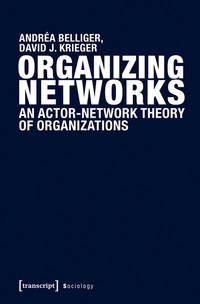
Organizing Networks
An Actor-Network Theory of Organizations
1st Edition
Published on 4. July 2023
Book
Paperback/Softback
272 pages
978-3-8376-3616-1 (ISBN)
Description
What are organizations? Where do they come from? How are they transformed and adapted to new situations? In the digital age and in the global network society, traditional theories of the organization can no longer answer these questions. Based on actor-network theory, this book explains organizations as flexible, open networks in which both human and non-human actors enter into socio-technical assemblies by constantly negotiating and re-negotiating programs of action. Organizations are not macro social structures or autonomous systems operating behind the backs of individuals. Instead, they are scalable actor-networks guided by network norms of connectivity, flow, communication, participation, authenticity, and flexibility.
More details
Other editions
Additional editions
E-Book
08/2016
1st Edition
transcript
€34.99
Available for download
Persons
Author
Andréa Belliger, Institut für Kommunikation & Führung, Schweiz
Andréa Belliger (Prof. Dr.) ist Co-Direktorin des Instituts für Kommunikation & Führung in Luzern und Prorektorin der Pädagogischen Hochschule Zentralschweiz. Sie ist Verwaltungsrätin in verschiedenen Unternehmen in den Bereichen Gesundheit, Finanzen und Banken, Sozialverwaltung, Energie und Bildung sowie als Beraterin für Unternehmen und Behörden in allen Aspekten der digitalen Transformation tätig. 2018/19 wurde sie unter die Top 100 Women in Business in der Schweiz gewählt und war für den Female Digital Leader Award nominiert.
ISNI:
David J. Krieger, IKF – Institut für Kommunikation und Führung, Schweiz
David J. Krieger (Prof. Dr. habil. habil.), Philosoph, ist Direktor des IKF - Institut für Kommunikation und Führung in Luzern. Er war Mitbegründer des Instituts für Kommunikation und Kultur an der Universität Luzern, wo er sich in Religionswissenschaft und in Kommunikationswissenschaft habilitiert hat. Seine Forschungsschwerpunkte liegen in den Bereichen Akteur-Netzwerk-Theorie, Systemtheorie, Hermeneutik, Informationstheorie, Digitale Ethik und Neue Medien.