

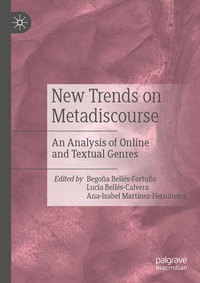
New Trends on Metadiscourse
An Analysis of Online and Textual Genres
Published on 23. December 2024
Book
Paperback/Softback
X, 262 pages
978-3-031-36692-5 (ISBN)
Description
This edited book gives an updated overview of methods of analysis of academic and non-academic genres in a digital era. The advent of digital and social media has deeply transformed academic and non-academic communication practices in the past two decades. The linguistic landscape is now a multilayered one; multicultural issues and cross-linguistic aspects are addressed in a way to understand how linguistically and culturally diverse identities try to find pathways. The communicative immediacy of digital media and the spectrum of genres/hybridized forms now available has inevitably influenced the way we communicate and the way we create meaning-making in a multimodal environment. The book contains nine chapters divided into two main sections corresponding to academic and non-academic texts where written, spoken and digital genres are examined from different perspectives. Cross-linguistic studies, multilingual approaches or disciplinary variations are analyzed in detail. This book provides and up-to-date and innovative view of Metadiscourse research and develops new research methodologies, drawing on visual research methods and combinations of qualitative and quantitative approaches from fields including Discourse Analysis, Corpus Linguistics, and Genre Analysis.
Reviews / Votes
"The book promises to be a useful read for scholars and teachers interested in studying the adaptation of metadiscourse practices in different genres and social contexts. From the intended audience's perspective, the inclusion of some recommendations for ESP practitioners addressing teaching and using in practice the persuasive potential of metadiscourse, multimodal resources, identity construction and miscommunication risks might have been a welcome addition to the volume." (Olga Dontcheva-Navratilova, ESP Today, Vol. 13 (1), 2025)
More details
Language
English
Place of publication
Cham
Switzerland
Publishing group
Springer International Publishing
Target group
Professional and scholarly
Illustrations
35 s/w Abbildungen, 33 farbige Abbildungen
X, 262 p. 68 illus., 33 illus. in color.
Dimensions
Height: 210 mm
Width: 148 mm
Thickness: 15 mm
Weight
356 gr
ISBN-13
978-3-031-36692-5 (9783031366925)
DOI
10.1007/978-3-031-36690-1
Schweitzer Classification
Other editions
Additional editions
Begoña Bellés-Fortuño | Lucía Bellés-Calvera | Ana-Isabel Martínez-Hernández
New Trends on Metadiscourse
An Analysis of Online and Textual Genres
Book
12/2023
Palgrave Macmillan
€160.49
Shipment within 15-20 days
Persons
Begoña Bellés-Fortuño
is a senior lecturer in the Department of English Studies at Universitat Jaume I, Spain.
Lucía Bellés-Calvera is a PhD part-time adjunct lecturer at Universitat Jaume I, Spain.
Ana-Isabel Martínez-Hernández is a part-time adjunct lecturer in the Department of Translation and Communication Studies at Universitat Jaume I, Spain.
Lucía Bellés-Calvera is a PhD part-time adjunct lecturer at Universitat Jaume I, Spain.
Ana-Isabel Martínez-Hernández is a part-time adjunct lecturer in the Department of Translation and Communication Studies at Universitat Jaume I, Spain.
Content
Part I: Academic Genres.- CHAPTER 1: So what do we have here? An engineering lecturer's metadiscursive use of rhetorical questions in L1 and English-medium instruction (Sarah Khan and Marta Aguilar).- CHAPTER 2: Distribution Patterns of Stance Features in English and Russian Conference Presentations (Galiya Gatiyatullina, Marina Solnyskina, Roman Kupriyanov and Elzara Gafiyatova).- CHAPTER 3: A metadiscoursal approach to academic writers' construal of identities across brief reports and case reports in medical science (Sabiha Choura).- CHAPTER 4: Metadiscourse Learning Trajectories in Multilingual Learners: A Focus on Attitude Markers and Hedges (Sofía Martín-Laguna).- CHAPTER 5: A contrastive analysis of metadiscourse by native and EFL lecturers in Chinese university MOOCs (Dongyun Zhang and Diyun Sheng).- Part II: Non-academic Genres.- CHAPTER 6: Using Twitter for public dissemination and engagement with science: metadiscourse in the Twitter of scientific organisations (María José Luzón).- CHAPTER 7: Persuasion through interactional metadiscourse of management statements of European renewable energy companies (Maria Cristina Urloi and Miguel F. Ruiz-Garrido).- CHAPTER 8: On the metadiscursive dimension of travel blog posts: a cross-linguistic analysis (Giuliana Diani).- CHAPTER 9: 'I think, you know.': A corpus-based analysis of Metadiscourse in Malaysian Online Podcasts (Syamimi Turiman and Siti Aeisha Joharry).