

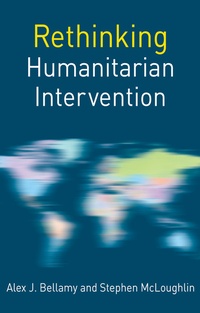
Rethinking Humanitarian Intervention
Description
Humanitarian intervention is one of the most controversial issues in contemporary world politics. Emerging norms of human protection, which have their roots in the 1990s but have become more prominent since the turn of the century, have changed international practices and debates about how international society should respond to the problem of genocide and mass atrocities. Assuming no prior knowledge, and written for students and general readers as well as practitioners and scholars, this important new book by a leading expert addresses a range of key challenges in the wake of the experiences of Iraq, Libya and Syria including the consistency, efficacy and accountability of intervention, and whether regime change and unilateral intervention are ever justified.
Reviews / Votes
This comprehensive introduction offers a timely reassessment of key debates. The authors show expert insight into the big questions surrounding human protection, regime change, and consistency. In so doing, it acts as a much needed addition to any reading list. * Adrian Gallagher, University of Leeds, UK * This text is an important contribution to the humanitarian intervention literature. While most writers focus on either collective or individual intervention, this book harnesses both in interesting ways, incorporating the most up to date empirical research. * Fernando Teson, Florida State University College of Law, USA *More details
Other editions
Additional editions
Persons
Alex J. Bellamy is Professor of Peace and Conflict Studies and Director of the Asia Pacific Centre for the Responsibility to Protect at the University of Queensland, Australia. He is also Fellow of the Academy of Social Sciences in Australia and Non-Resident Senior Adviser at the International Peace Institute, New York. Recent books include, East Asia's Other Miracle: Explaining the Decline of Mass Atrocities (Oxford, 2017), The Responsibility to Protect: A Defense (Oxford, 2015) and Massacres and Morality: Mass Killing in an Age of Civilian Immunity (Oxford, 2012).
Stephen McLoughlin is a Lecturer in International Relations, and Convener of the MA Peace Studies Program at Liverpool Hope. His research interests include mass atrocity prevention, the role of the UN in conceptualising and carrying out prevention, the causes of genocide and mass atrocities, and the Responsibility to Protect (R2P). He is also the deputy director of the Desmond Tutu Centre for War and Peace Studies.
Content
Introduction.- Chapter 1 - Atrocities and Responses.- Chapter 2 - Towards Human Protection.- Chapter 3 - Protection Without Force.- Chapter 4 - Intervention in Libya.- Chapter 5 - The Problem of Regime Change.- Chapter 6 - The Problem of Accountability.- Chapter 7 - Consistency and Complications.- Chapter 8 - Human Protection in Crisis?