

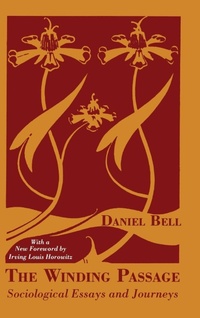
The Winding Passage
Sociological Essays and Journeys
1st Edition
Published on 18. December 2020
Book
Hardback
400 pages
978-1-138-53950-1 (ISBN)
Description
This collection brings together Daniel Bell's best work in essay form. It deals with a variety of topics: technology and culture, religion and personal identity, intellectuals and their societies, and the uses and abuses of doctrines of social class. The Winding Passage demonstrates the author's continuing concern with the salient issues of our times, while its inspiration draws upon an older, humanistic sociological tradition.
In a central essay on intellectuals, Bell examines the term new class and calls it a muddle. Though the idea of class has been relevant to Western industrial society for the past two hundred years, the concept is less useful for examining Communist states, the Third World, and even the emerging postindustrial sectors of the West. Bell seeks to establish the idea of situs, the competitive conflict of functional groups for shares in the state budgetary process.
A more personal note is struck in the final section of the book. In reflecting on the nature of intellectual life, the special role of the Jewish intellectual, and the tension between the claims of the parochial and the universal, Bell uses as a general framework antinomianism, the claims of individual conscience against authority, law, and established institutions. And in a final statement, "The Return of the Sacred," Bell explores the enlightenment belief in the dissolution of religion and attempts to show why it was wrong. This is a must book for those concerned with the sociology of knowledge, intellectual history, and social stratification.
Speaking of The Winding Passage, Seymour Martin Lipset called the book "sociological analysis at its best" Irving Howe noted that "Bell is always worth listening to. He is a true intellectual." And Irving Louis Horowitz, in his review of the book, calls it "the sifted excellence of a civilized and urbane intellectual.
In a central essay on intellectuals, Bell examines the term new class and calls it a muddle. Though the idea of class has been relevant to Western industrial society for the past two hundred years, the concept is less useful for examining Communist states, the Third World, and even the emerging postindustrial sectors of the West. Bell seeks to establish the idea of situs, the competitive conflict of functional groups for shares in the state budgetary process.
A more personal note is struck in the final section of the book. In reflecting on the nature of intellectual life, the special role of the Jewish intellectual, and the tension between the claims of the parochial and the universal, Bell uses as a general framework antinomianism, the claims of individual conscience against authority, law, and established institutions. And in a final statement, "The Return of the Sacred," Bell explores the enlightenment belief in the dissolution of religion and attempts to show why it was wrong. This is a must book for those concerned with the sociology of knowledge, intellectual history, and social stratification.
Speaking of The Winding Passage, Seymour Martin Lipset called the book "sociological analysis at its best" Irving Howe noted that "Bell is always worth listening to. He is a true intellectual." And Irving Louis Horowitz, in his review of the book, calls it "the sifted excellence of a civilized and urbane intellectual.
More details
Language
English
Place of publication
London
United Kingdom
Publishing group
Taylor & Francis Ltd
Target group
College/higher education
Dimensions
Height: 235 mm
Width: 157 mm
Thickness: 26 mm
Weight
731 gr
ISBN-13
978-1-138-53950-1 (9781138539501)
Copyright in bibliographic data and cover images is held by Nielsen Book Services Limited or by the publishers or by their respective licensors: all rights reserved.
Schweitzer Classification
Other editions
Additional editions
Book
07/2021
1st Edition
Transaction Publishers
€73.50
Article not available at the moment
E-Book
02/2020
1st Edition
Routledge
€65.99
Available for download
E-Book
02/2020
1st Edition
Routledge
€65.99
Available for download
Person
Daniel Bell (1919-2011) was professor emeritus of sociology at Harvard University and is best known for his work and contributions to post-industrialism. He had been editor of the publications The New Leader, Fortune, and The Public Interest. He is the author of The End of Ideology, The Winding Passage: Sociological Essays and Journeys, and The Social Sciences since the Second World War.
Content
Foreword, Preface, Part I - Techne and Themis, Part II - Prophets of Utopia, Part III - The Intellectuals and "The New Class", Part IV - Directions of Social Change, Part V - Culture and Beliefs, Acknowledgements, Index