

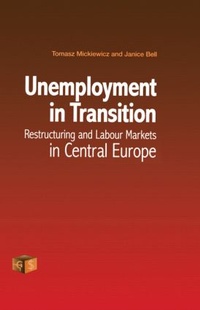
Unemployment in Transition
Restructuring and Labour Markets in Central Europe
Published on 23. January 2001
Book
Hardback
238 pages
978-90-5823-103-1 (ISBN)
Description
The emergence of open unemployment is an unavoidable consequence of postcommunist transition. Some countries-notably in the former Soviet Union-initially slowed economic contraction. But in the longer run slower reformers have generally sustained deeper and more prolonged recessions than faster reforming central European countries. Moreover, the initially low unemployment rates in the former Soviet Union are now rising, and may stabilise at higher post-transition equilibrium rates than in Central Europe.
Reviews / Votes
(This) book represents a very important contribution to current debates on the labour market dynamics in transition economies. It provides a comprehensive outline of the most important issuesMore details
Series
Language
English
Place of publication
London
United Kingdom
Publishing group
Taylor & Francis Ltd
Target group
College/higher education
Dimensions
Height: 229 mm
Width: 152 mm
Weight
600 gr
ISBN-13
978-90-5823-103-1 (9789058231031)
Copyright in bibliographic data and cover images is held by Nielsen Book Services Limited or by the publishers or by their respective licensors: all rights reserved.
Schweitzer Classification
Other editions
Additional editions
Janice Bell | Tomasz Mickiewicz
Unemployment in Transition
Restructuring and Labour Markets in Central Europe
E-Book
09/2013
1st Edition
Routledge
€60.49
Available for download
Janice Bell | Tomasz Mickiewicz
Unemployment in Transition
Restructuring and Labour Markets in Central Europe
E-Book
09/2013
1st Edition
Routledge
€60.49
Available for download
Persons
Bell, Janice; Mickiewicz, Tomasz
Content
Introduction; Chapter 1 Employment and Unemployment During Economic Transition; Chapter 2 Wages and Unemployment; Chapter 3 Restructuring of Employment; Chapter 4 Restructuring of Employment; Chapter 5 Labour Market Institutions; Chapter 6 Unemployment and Growth Paths During the Post-Communist Transition;