


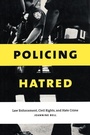
Policing Hatred
Law Enforcement, Civil Rights, and Hate Crime
Published on 12. July 2004
Book
Paperback/Softback
227 pages
978-0-8147-9898-0 (ISBN)
Description
Explores the intersection of race and law enforcement in the controversial area of hate crime
High-profile hate crimes like the torture-murder of Matthew Shepard and the dragging death of James Byrd have drawn the nation's attention, but there are thousands of other individuals who are attacked because of their race, religion, or sexual orientation each year. This study of hate crimes challenges common assumptions regarding perpetrators and victims: most of the accused tend to be white, while most of their victims are not.
Policing Hatred is an in-depth ethnographic study of how hate crime law works in practice, from the perspective of those enforcing it. It examines the ways in which the police handle bias crimes, and the social impact of those efforts. Bell exposes the power that law enforcement personnel have to influence the social environment by showing how they determine whether an incident will be charged as a bias crime.
Drawing on her unprecedented access to a police hate crime unit, Bell's work brings to life the stories of female, Black, Latino, and Asian American detectives, in addition to those of their white male counterparts. Policing Hatred also explores the impact of victim's identity on each officers handling of bias crimes and addresses how the police treat defendants' First Amendment rights. Bell's vivid evidence from the field argues persuasively for the need to have the police diligently address even low-level offenses, such as vandalism, given their devastating cumulative effects on society.
High-profile hate crimes like the torture-murder of Matthew Shepard and the dragging death of James Byrd have drawn the nation's attention, but there are thousands of other individuals who are attacked because of their race, religion, or sexual orientation each year. This study of hate crimes challenges common assumptions regarding perpetrators and victims: most of the accused tend to be white, while most of their victims are not.
Policing Hatred is an in-depth ethnographic study of how hate crime law works in practice, from the perspective of those enforcing it. It examines the ways in which the police handle bias crimes, and the social impact of those efforts. Bell exposes the power that law enforcement personnel have to influence the social environment by showing how they determine whether an incident will be charged as a bias crime.
Drawing on her unprecedented access to a police hate crime unit, Bell's work brings to life the stories of female, Black, Latino, and Asian American detectives, in addition to those of their white male counterparts. Policing Hatred also explores the impact of victim's identity on each officers handling of bias crimes and addresses how the police treat defendants' First Amendment rights. Bell's vivid evidence from the field argues persuasively for the need to have the police diligently address even low-level offenses, such as vandalism, given their devastating cumulative effects on society.
Reviews / Votes
"This useful and timely book deals with the ethnographic basis of hate crime." (Choice) "Readable and interesting...a fine work that offers fresh insights into how the police enforce hate crime laws." (Law and Politics Book Review) A very well written analysis of the process of enforcing hate crimes. Policing Hatred illuminates basic matters of policing in a democratic society-balancing victims rights versus the rights of suspects, the role of public ignorance and political pressure on police work, and the quite striking decency of these investigators. . . . Will be a & must read for all social scientists interested in hate crime as well as scholars in criminal justice, law, sociology, and political science in the area of police studies. - Peter K. Manning,Brooks Chair of Policing and Criminal Justice, College of Criminal Justice, Northeastern UniversityMore details
Series
Edition
Revised edition
Language
English
Place of publication
New York
United States
Target group
Professional and scholarly
Product notice
Paperback (trade)
Dimensions
Height: 228 mm
Width: 164 mm
Thickness: 16 mm
Weight
331 gr
ISBN-13
978-0-8147-9898-0 (9780814798980)
Copyright in bibliographic data and cover images is held by Nielsen Book Services Limited or by the publishers or by their respective licensors: all rights reserved.
Schweitzer Classification
Other editions
Additional editions
E-Book
07/2002
New York University Press
€142.99
Available for download

E-Book
07/2002
New York University Press
€29.49
Available for download
Person
Jeannine Bell is Professor of Law at IU Maurer School of Law-Bloomington. She is the author of Policing Hatred: Law Enforcement, Civil Rights, and Hate Crime; Police and Policing Law; and Gaining Access to Research Sites: A Practical and Theoretical Guide for Qualitative Researchers (with Martha Feldman and Michele Berger).
Content
1 Introduction 2 The Framework of Police Decision-Making in Hate Crime Cases 3 Integration and Hate Crime: The Institutionalization of Civil Rights Law 4 Investigation: Detectives and the Making of Hate Crime 5 The Difficulty of Hate Crime Investigation 6 Police Culture and Hate Crime 7 The Decision to Seek Charges 8 Prosecutors and the Courts 9 Conclusion