

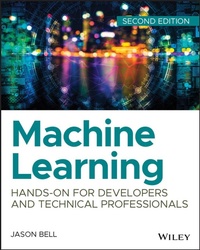
Machine Learning: Hands-On for Developers and Technical Professionals
Hands-On for Developers and Technical Professionals
2nd Edition
Published on 13. March 2020
Book
Paperback/Softback
400 pages
978-1-119-64214-5 (ISBN)
Description
Dig deep into the data with a hands-on guide to machine learning with updated examples and more!
Machine Learning: Hands-On for Developers and Technical Professionals provides hands-on instruction and fully-coded working examples for the most common machine learning techniques used by developers and technical professionals. The book contains a breakdown of each ML variant, explaining how it works and how it is used within certain industries, allowing readers to incorporate the presented techniques into their own work as they follow along. A core tenant of machine learning is a strong focus on data preparation, and a full exploration of the various types of learning algorithms illustrates how the proper tools can help any developer extract information and insights from existing data. The book includes a full complement of Instructor's Materials to facilitate use in the classroom, making this resource useful for students and as a professional reference.
At its core, machine learning is a mathematical, algorithm-based technology that forms the basis of historical data mining and modern big data science. Scientific analysis of big data requires a working knowledge of machine learning, which forms predictions based on known properties learned from training data. Machine Learning is an accessible, comprehensive guide for the non-mathematician, providing clear guidance that allows readers to:
* Learn the languages of machine learning including Hadoop, Mahout, and Weka
* Understand decision trees, Bayesian networks, and artificial neural networks
* Implement Association Rule, Real Time, and Batch learning
* Develop a strategic plan for safe, effective, and efficient machine learning
By learning to construct a system that can learn from data, readers can increase their utility across industries. Machine learning sits at the core of deep dive data analysis and visualization, which is increasingly in demand as companies discover the goldmine hiding in their existing data. For the tech professional involved in data science, Machine Learning: Hands-On for Developers and Technical Professionals provides the skills and techniques required to dig deeper.
Machine Learning: Hands-On for Developers and Technical Professionals provides hands-on instruction and fully-coded working examples for the most common machine learning techniques used by developers and technical professionals. The book contains a breakdown of each ML variant, explaining how it works and how it is used within certain industries, allowing readers to incorporate the presented techniques into their own work as they follow along. A core tenant of machine learning is a strong focus on data preparation, and a full exploration of the various types of learning algorithms illustrates how the proper tools can help any developer extract information and insights from existing data. The book includes a full complement of Instructor's Materials to facilitate use in the classroom, making this resource useful for students and as a professional reference.
At its core, machine learning is a mathematical, algorithm-based technology that forms the basis of historical data mining and modern big data science. Scientific analysis of big data requires a working knowledge of machine learning, which forms predictions based on known properties learned from training data. Machine Learning is an accessible, comprehensive guide for the non-mathematician, providing clear guidance that allows readers to:
* Learn the languages of machine learning including Hadoop, Mahout, and Weka
* Understand decision trees, Bayesian networks, and artificial neural networks
* Implement Association Rule, Real Time, and Batch learning
* Develop a strategic plan for safe, effective, and efficient machine learning
By learning to construct a system that can learn from data, readers can increase their utility across industries. Machine learning sits at the core of deep dive data analysis and visualization, which is increasingly in demand as companies discover the goldmine hiding in their existing data. For the tech professional involved in data science, Machine Learning: Hands-On for Developers and Technical Professionals provides the skills and techniques required to dig deeper.
More details
Other editions
Additional editions
E-Book
02/2020
2nd Edition
Wiley
€34.99
Available for download
E-Book
02/2020
2nd Edition
Wiley
€34.99
Available for download
Previous edition
Book
12/2014
Wiley
€55.90
Article exhausted; check for reprint
Content
Chapter 1: What is Machine Learning?
Chapter 2: Planning for Machine Learning
Chapter 3: Data Acquisition Techniques
Chapter 4: Revisiting Basic Statistics and Linear Regression
Chapter 5: Working with Decision Trees
Chapter 6: Clustering
Chapter 7: Association Rules Learning
Chapter 8: Support Vector Machines
Chapter 9: Artifical Neural Networks and Deep Learning
Chapter 10: Machine Learning from Text Documents
Chapter 11: Machine Learning from Image Information
Chapter 12: Machine Learning from Streaming Data with Apache Kafka
Chapter 13: Apache Spark and MLLib
Chapter 14: Maching Learing with R
Appx A: A Kafka Quick Start
Appx B: Spark 1.x Quick Start
Appx C: Useful Unix Commands
Appx D: Further Reading
Chapter 2: Planning for Machine Learning
Chapter 3: Data Acquisition Techniques
Chapter 4: Revisiting Basic Statistics and Linear Regression
Chapter 5: Working with Decision Trees
Chapter 6: Clustering
Chapter 7: Association Rules Learning
Chapter 8: Support Vector Machines
Chapter 9: Artifical Neural Networks and Deep Learning
Chapter 10: Machine Learning from Text Documents
Chapter 11: Machine Learning from Image Information
Chapter 12: Machine Learning from Streaming Data with Apache Kafka
Chapter 13: Apache Spark and MLLib
Chapter 14: Maching Learing with R
Appx A: A Kafka Quick Start
Appx B: Spark 1.x Quick Start
Appx C: Useful Unix Commands
Appx D: Further Reading