

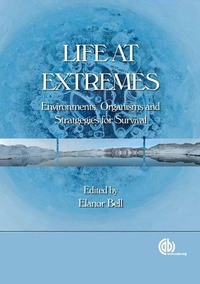
Life at Extremes
Environments, Organisms and Strategies for Survival
Will be published approx. on 22. March 2012
Book
Hardback
576 pages
978-1-84593-814-7 (ISBN)
Description
From icy poles to arid deserts, boiling pools to the depths of the sea, this exciting new work studies the remarkable life forms that have made these inhospitable environments their home. The ecological, biological and biogeochemical challenges that higher-level plants and animals, microorganisms and viruses face are detailed, and the unifying themes found between environments discussed. A fascinating and comprehensive resource for researchers and students, this book is packed with colour figures and photos showcasing the most extreme environments and the organisms that have adapted to live in them.
More details
Language
English
Place of publication
Wallingford
United Kingdom
Target group
College/higher education
Product notice
sewn/stitched
Paper over boards
Dimensions
Height: 246 mm
Width: 178 mm
Thickness: 36 mm
Weight
1578 gr
ISBN-13
978-1-84593-814-7 (9781845938147)
Copyright in bibliographic data and cover images is held by Nielsen Book Services Limited or by the publishers or by their respective licensors: all rights reserved.
Schweitzer Classification
Persons
Elanor Bell completed a PhD in 1998 having studied the microbial ecology of Antarctic saline lakes in the Vestfold Hills, Eastern Antarctica. She went on to hold postdoctoral positions at McGill University, Canada, and Potsdam University, Germany, before becoming a lecturer in Marine Microbial Ecology and Marine Conservation at The Scottish Association for Marine Science/ University of the Highlands and Islands, Scotland, United Kingdom. She has wintered twice in the Vestfold Hills, Antarctica, spent an extended season in the Dry Valleys, Antarctica and several seasons in the Arctic. Elanor has recently moved to Tasmania, Australia with her two young children and partner.
Content
1: What are extreme environments and what lives in them? 2: Past extremes 3: Polar marine ecosystems 4: Sea ice 5: Polar terrestrial environments 6: Polar freshwaters: high altitude and latitude lakes 7: Subglacial lakes 8: Cold alpine regions 9: Glacier surface habitats 10: Polar deserts 11: Hot desert environments 12: Terrestrial hydrothermal environments 13: Deep-sea hydrothermal vents 14: High hydrostatic pressure environments 15: Deep sea 16: Caves and karst environments 17: The deep biosphere: deep subterranean and subseafloor habitats 18: Acidic environments 19: Life in alkaline environments and alkaliphiles 20: Hypersaline environments and halophiles 21: Hypoxic environments 22: High ultraviolet radiation environments 23: Life in a changing climate 24: Anthropogenic extreme environments 25: Biotechnological applications of extremophiles: promise and prospects 26: Extreme environments on Earth as analogues for life on other planets: astrobiology 27: Concluding remarks