

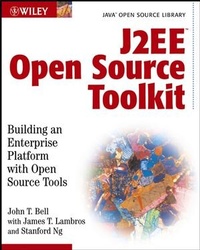
J2EE Open Source Toolkit
Building an Enterprise Platform with Open Source Tools (Java Open Source Library)
1st Edition
Published on 26. September 2003
Book
Paperback/Softback
648 pages
978-0-471-44435-0 (ISBN)
Description
* The first book that shows how to harness the full power of open-source tools to build a free J2EE development platform without using any commercial products
* Tools covered include Apache Tomcat, Struts, Jetspeed, MySQL, Joram, and jBoss
* Shows developers how to integrate all of the most popular open-source tools into a single, integrated platform
* Companion Web site provides source code plus a fully working example of the development platform created in the book
* Tools covered include Apache Tomcat, Struts, Jetspeed, MySQL, Joram, and jBoss
* Shows developers how to integrate all of the most popular open-source tools into a single, integrated platform
* Companion Web site provides source code plus a fully working example of the development platform created in the book
More details
Edition
1., Auflage
Language
English
Place of publication
New York
United States
Publishing group
John Wiley and Sons Ltd
Target group
College/higher education
Professional and scholarly
Illustrations
Illustrations
Dimensions
Height: 23.4 cm
Width: 18.8 cm
Thickness: 35 mm
Weight
961 gr
ISBN-13
978-0-471-44435-0 (9780471444350)
Schweitzer Classification
Other editions
Additional editions
John T. Bell | James Lambros | Stan Ng
J2EE Open Source Toolkit
Building an Enterprise Platform with Open Source Tools (Java Open Source Library)
E-Book
10/2003
Wiley
€45.50
Available for download
Persons
JOHN T. BELL is an instructor of server-side Java technologies for the Center for Applied Information Technology at Towson State University in Maryland. He also serves as a technical architect for a major hospitality company.
JAMES T. LAMBROS is a software architect/analyst for Caterpillar Financial Corporation. He has also been involved with several software development projects during his career with IBM.
STANFORD NG is the cofounder of Nuglu, LLC and directing software development at ciMediaGroup, a division of Creative Images. He is a coconspirator with Dr. Robert Nideffer behind the international award-winning Proxy/MAM research project.
JAMES T. LAMBROS is a software architect/analyst for Caterpillar Financial Corporation. He has also been involved with several software development projects during his career with IBM.
STANFORD NG is the cofounder of Nuglu, LLC and directing software development at ciMediaGroup, a division of Creative Images. He is a coconspirator with Dr. Robert Nideffer behind the international award-winning Proxy/MAM research project.
Content
Acknowledgments.
About the Authors.
Introduction.
Part 1: At the Starting Gate.
Chapter 1: Leveraging Open Source Software.
Chapter 2: Java Enterprise Architecture.
Chapter 3: Selecting the Right Platform Components.
Part 2: Integrating the Web Tier.
Chapter 5: Powering the Web Tier with a Server Container.
Chapter 6: Creating Dynamic Content Using Template Engines.
Chapter 7: Adding a Web Application Framework.
Part 3: Building the Infrastructure.
Chapter 8: Managing Data Using JDBC and Databases.
Chapter 9: Messaging with JMS.
Chapter 10: Implementing an EJB Container.
Chapter 11: Providing Web Services.
Chapter 12: Adding XML Power Tools.
Part 4: Test Driving the Platform.
Chapter 13: Building an Application: Assembling the Back End.
Chapter 14: Building an Application: Assembling the Front End.
Chapter 15: Deploying and Running Your Application.
Index.
About the Authors.
Introduction.
Part 1: At the Starting Gate.
Chapter 1: Leveraging Open Source Software.
Chapter 2: Java Enterprise Architecture.
Chapter 3: Selecting the Right Platform Components.
Part 2: Integrating the Web Tier.
Chapter 5: Powering the Web Tier with a Server Container.
Chapter 6: Creating Dynamic Content Using Template Engines.
Chapter 7: Adding a Web Application Framework.
Part 3: Building the Infrastructure.
Chapter 8: Managing Data Using JDBC and Databases.
Chapter 9: Messaging with JMS.
Chapter 10: Implementing an EJB Container.
Chapter 11: Providing Web Services.
Chapter 12: Adding XML Power Tools.
Part 4: Test Driving the Platform.
Chapter 13: Building an Application: Assembling the Back End.
Chapter 14: Building an Application: Assembling the Front End.
Chapter 15: Deploying and Running Your Application.
Index.