

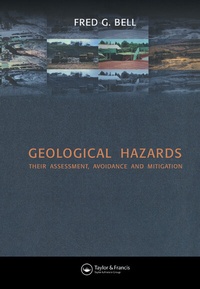
Geological Hazards
Their Assessment, Avoidance and Mitigation
1st Edition
Published on 25. February 1999
Book
Hardback
656 pages
978-0-419-16970-3 (ISBN)
Description
Natural hazards cost the global economy over $50,000 million per year. Two thirds of this is spent on damage repair, the remainder represents the cost of predicting, preventing and mitigating against disasters. Man-made hazards such as groundwater pollution, subsidence and soil erosion add to this figure.
Geological Hazards is the first book to consider both natural and man-made disasters in a single volume. All major geological hazards are examined. It presents a state-of-the art survey for students on civil engineering and physical geography courses, as well as researchers and practicing civil engineers. It examines methods of assessing, evaluating and combatting hazards, both natural and man-made. Richly illustrated, it views the subject from an international perspective.
Geological Hazards is the first book to consider both natural and man-made disasters in a single volume. All major geological hazards are examined. It presents a state-of-the art survey for students on civil engineering and physical geography courses, as well as researchers and practicing civil engineers. It examines methods of assessing, evaluating and combatting hazards, both natural and man-made. Richly illustrated, it views the subject from an international perspective.
Reviews / Votes
"The author is to be congratulated on the large number of examples he cites, drawn from many parts of the world and with excellent UK representation." Geographical Association 2/01"Although dealing with highly complex phenomena, the content of this volume is readily accessible by non-specialists, those in management roles, or those generally seeking a better understanding of geohazard phenomena." The Australasian Journal of Disaster and Trauma Studies Volume 2001/2
"The discussion of hazards is both Comprehensive and critical and Bell does a good job of clarifying the complexity and uncertainty inherent in the study of geohazards. This critical focus further enhances the utility of this volume as an aid to comprehensive all-hazards planning." The Australasian Journal of Disaster and Trauma Studies Volume 2001/2
"...an essential resource for those in emergency management and planning." The Australasian Journal of Disaster and Trauma Studies Volume 2001/2
"...an excellent and accessible review of diverse hazard phenomena and one that should be regarded as essential reading for anyone requiring a detailed and comprehensive summery of hazard phenomena and who is grappling with the complexities of developing all-hazards plans and response capabilities." The Australasian Journal of Disaster and Trauma Studies Volume 2001/2
"Geological Hazards is a welcome and valuable addition to the literature covering this subject. Its wide and balanced approach to the subject will be of great use to educators, researchers and planners and fills a clear gap in the subject. It is very well written and as an accessible and informative text interested undergraduates will read it avidly." The Geographical Journal 2002
More details
Language
English
Place of publication
London
United Kingdom
Publishing group
Taylor & Francis Ltd
Target group
College/higher education
Professional and scholarly
Illustrations
97 s/w Tabellen
97 Tables, black and white
Dimensions
Height: 234 mm
Width: 156 mm
Weight
1370 gr
ISBN-13
978-0-419-16970-3 (9780419169703)
Copyright in bibliographic data and cover images is held by Nielsen Book Services Limited or by the publishers or by their respective licensors: all rights reserved.
Schweitzer Classification
Other editions
Additional editions
Book
02/2003
1st Edition
CRC Press
€189.80
Shipment within 15-20 days
E-Book
02/1999
1st Edition
CRC Press
€172.99
Available for download
E-Book
02/1999
CRC Press
€172.99
Available for download
Person
Fred Bell is Professor and Head of Department of Geology and Applied Geology at the University of Natal
Content
Part One: Geohazards: Assessments and Planning. Part Two: Volcanic Activity. Part Three. Earthquake Activity. Part Four: Mass Movements. Part Five: Problem Soils. Part Six: River Action and Control. Part Seven: Marine Action and Control. Part Eight: Wind Action and Arid Regions. Part Nine: Soil Erosion and Desertification. Part Ten: Waste and its Disposal. Part Eleven: Groundwater Pollution. Part Twelve: Ground Subsidence. Index.