

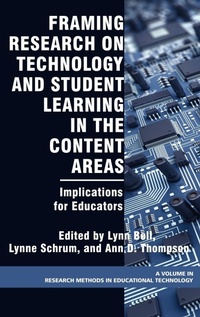
Framing Research on Technology and Student Learning in the Content Areas
Implications for Educators
Will be published approx. on 6. November 2008
Book
Hardback
192 pages
978-1-59311-707-8 (ISBN)
Description
This book is a result of collaboration between NTLS and SITTE.
Framing Research is targeted at individuals or small teams of educational researchers who are interested in conducting high quality research addressing the effects of technology-enhanced instruction on student learning. The book summarizes and unpacks the methodologies of a variety of research studies, each situated in the context of school subject areas, such as science, mathematics, social studies, and English/language arts, as well as in the contexts of reading education, special education, and early childhood learning. Taken together, the analyses provide guidance on the design of future technology research grounded in student learning of K-12 curriculum. The conclusions also serve as a tool for teacher educators seeking to prepare teachers to integrate technology effectively in their instruction and to motivate reluctant teachers to overcome perceived inconveniences connected with technology use.
Framing Research is targeted at individuals or small teams of educational researchers who are interested in conducting high quality research addressing the effects of technology-enhanced instruction on student learning. The book summarizes and unpacks the methodologies of a variety of research studies, each situated in the context of school subject areas, such as science, mathematics, social studies, and English/language arts, as well as in the contexts of reading education, special education, and early childhood learning. Taken together, the analyses provide guidance on the design of future technology research grounded in student learning of K-12 curriculum. The conclusions also serve as a tool for teacher educators seeking to prepare teachers to integrate technology effectively in their instruction and to motivate reluctant teachers to overcome perceived inconveniences connected with technology use.
More details
Series
Language
English
Place of publication
Charlotte
United States
Publishing group
Emerald Publishing Inc
Target group
Professional and scholarly
Illustrations
illustrations
Dimensions
Height: 240 mm
Width: 161 mm
Thickness: 15 mm
Weight
458 gr
ISBN-13
978-1-59311-707-8 (9781593117078)
Copyright in bibliographic data and cover images is held by Nielsen Book Services Limited or by the publishers or by their respective licensors: all rights reserved.
Schweitzer Classification
Persons
Content
Preface.
Chapter 1. Introduction; Lynn Bell, Lynne Schrum, Ann Thompson, and Glen Bull.
Chapter 2. Framing the Research on Technology and Student Learning in Mathematics; Robert N. Ronau, Margaret L. Niess, Christine Browning, David Pugalee, Shannon O. Driskell and Rachel Harrington.
Chapter 3. Framing the Research on Technology and Student Learning in Science Education; John Park and David Slykuis.
Chapter 4. Framing the Research on Technology and Student Learning in the Social Studies; David Hicks, Adam Friedman, and John Lee.
Chapter 5. Framing the Research on Technology and Student Learning in English Education During an Era of Changing Literacy Practices; Carl A. Young, Troy Hicks, and Sara B. Kajder.
Chapter 6. Framing the Research on Technology and Student Learning in Reading; Michael C. McKenna and Carrie Simkin.
Chapter 7. Framing the Research on Technology and Student Learning in Early Childhood Education; Dina Rosen, X. Christine Wang, and Nicola Yelland.
Chapter 8. Framing the Research on Accessible Technology for Students With Mild Disabilities; Cindy L. Anderson and Kevin M. Anderson.
Chapter 9. From Teacher Preparation to Student Learning: An Example From Secondary Mathematics; Joe Garofalo, Nicole Juersivich, Jeffrey Steckroth, and Virginia Fraser.
Chapter 10. Conclusion; Debra Sprague and Melissa Pierson.
Chapter 1. Introduction; Lynn Bell, Lynne Schrum, Ann Thompson, and Glen Bull.
Chapter 2. Framing the Research on Technology and Student Learning in Mathematics; Robert N. Ronau, Margaret L. Niess, Christine Browning, David Pugalee, Shannon O. Driskell and Rachel Harrington.
Chapter 3. Framing the Research on Technology and Student Learning in Science Education; John Park and David Slykuis.
Chapter 4. Framing the Research on Technology and Student Learning in the Social Studies; David Hicks, Adam Friedman, and John Lee.
Chapter 5. Framing the Research on Technology and Student Learning in English Education During an Era of Changing Literacy Practices; Carl A. Young, Troy Hicks, and Sara B. Kajder.
Chapter 6. Framing the Research on Technology and Student Learning in Reading; Michael C. McKenna and Carrie Simkin.
Chapter 7. Framing the Research on Technology and Student Learning in Early Childhood Education; Dina Rosen, X. Christine Wang, and Nicola Yelland.
Chapter 8. Framing the Research on Accessible Technology for Students With Mild Disabilities; Cindy L. Anderson and Kevin M. Anderson.
Chapter 9. From Teacher Preparation to Student Learning: An Example From Secondary Mathematics; Joe Garofalo, Nicole Juersivich, Jeffrey Steckroth, and Virginia Fraser.
Chapter 10. Conclusion; Debra Sprague and Melissa Pierson.