

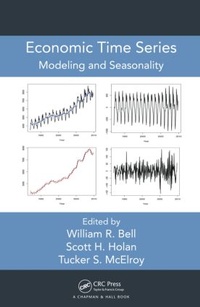
Economic Time Series
Modeling and Seasonality
1st Edition
Published on 19. March 2012
Book
Hardback
556 pages
978-1-4398-4657-5 (ISBN)
Description
Economic Time Series: Modeling and Seasonality is a focused resource on analysis of economic time series as pertains to modeling and seasonality, presenting cutting-edge research that would otherwise be scattered throughout diverse peer-reviewed journals. This compilation of 21 chapters showcases the cross-fertilization between the fields of time series modeling and seasonal adjustment, as is reflected both in the contents of the chapters and in their authorship, with contributors coming from academia and government statistical agencies.
For easier perusal and absorption, the contents have been grouped into seven topical sections:
Section I deals with periodic modeling of time series, introducing, applying, and comparing various seasonally periodic models
Section II examines the estimation of time series components when models for series are misspecified in some sense, and the broader implications this has for seasonal adjustment and business cycle estimation
Section III examines the quantification of error in X-11 seasonal adjustments, with comparisons to error in model-based seasonal adjustments
Section IV discusses some practical problems that arise in seasonal adjustment: developing asymmetric trend-cycle filters, dealing with both temporal and contemporaneous benchmark constraints, detecting trading-day effects in monthly and quarterly time series, and using diagnostics in conjunction with model-based seasonal adjustment
Section V explores outlier detection and the modeling of time series containing extreme values, developing new procedures and extending previous work
Section VI examines some alternative models and inference procedures for analysis of seasonal economic time series
Section VII deals with aspects of modeling, estimation, and forecasting for nonseasonal economic time series
By presenting new methodological developments as well as pertinent empirical analyses and reviews of established methods, the book provides much that is stimulating and practically useful for the serious researcher and analyst of economic time series.
For easier perusal and absorption, the contents have been grouped into seven topical sections:
Section I deals with periodic modeling of time series, introducing, applying, and comparing various seasonally periodic models
Section II examines the estimation of time series components when models for series are misspecified in some sense, and the broader implications this has for seasonal adjustment and business cycle estimation
Section III examines the quantification of error in X-11 seasonal adjustments, with comparisons to error in model-based seasonal adjustments
Section IV discusses some practical problems that arise in seasonal adjustment: developing asymmetric trend-cycle filters, dealing with both temporal and contemporaneous benchmark constraints, detecting trading-day effects in monthly and quarterly time series, and using diagnostics in conjunction with model-based seasonal adjustment
Section V explores outlier detection and the modeling of time series containing extreme values, developing new procedures and extending previous work
Section VI examines some alternative models and inference procedures for analysis of seasonal economic time series
Section VII deals with aspects of modeling, estimation, and forecasting for nonseasonal economic time series
By presenting new methodological developments as well as pertinent empirical analyses and reviews of established methods, the book provides much that is stimulating and practically useful for the serious researcher and analyst of economic time series.
Reviews / Votes
"This book is an excellent collection of articles about the modeling and seasonal adjustments of economic time series data by the leading experts in this field. ... As someone who often applies time series techniques to economic time series data in research, I found that I could still learn greatly by reading through this book. In particular, some of the discussions about the interactions of time series modeling and seasonal adjustments are very enlightening and useful. ...Overall this volume contains a collection of articles that will prove to be quite useful to researchers who want to do serious applied work in modeling the economic time series data."-Jun Ma, Journal of the American Statistical Association, March 2014
"The list of authors includes some of the leading contributors to the literature, including [editor] Bell. ... All chapters contain both theoretical development and also empirical applications to economic series. ... This volume is an ideal reference for those interested in recent developments in this literature."
-Alastair R. Hall, Journal of Times Series Analysis, June 2012
More details
Language
English
Place of publication
Oxford
United States
Publishing group
Taylor & Francis Inc
Target group
College/higher education
Researchers and graduate students in statistics and econometrics.
Illustrations
146 s/w Abbildungen, 89 s/w Tabellen
89 Tables, black and white; 146 Illustrations, black and white
Dimensions
Height: 234 mm
Width: 156 mm
Weight
907 gr
ISBN-13
978-1-4398-4657-5 (9781439846575)
Copyright in bibliographic data and cover images is held by Nielsen Book Services Limited or by the publishers or by their respective licensors: all rights reserved.
Schweitzer Classification
Other editions
Additional editions
E-Book
11/2018
Chapman and Hall
€73.99
Available for download
E-Book
11/2018
1st Edition
Chapman & Hall/CRC
€73.99
Available for download
Persons
William R. Bell, Ph.D., is the Senior Mathematical Statistician for Small Area Estimation at the U.S. Census Bureau. He is a recognized researcher in the area of modeling and adjustment of seasonal economic time series. He has also worked on development of related computer software, including software for RegARIMA modeling of seasonal economic time series (for the X-12-ARIMA seasonal adjustment program), and the REGCMPNT program for time series models with regression effects and ARIMA component errors.
Scott H. Holan, Ph.D., is an Associate Professor of Statistics at the University of Missouri. He is the author of over 30 articles on topics of time series, spatio-temporal methodology, Bayesian methods and hierarchical models. His work is largely motivated by problems in federal statistics, econometrics, ecology and environmental science.
Tucker S. McElroy, Ph.D., is a Principal Researcher for Time Series Analysis at the U.S. Census Bureau. His research is focused primarily upon developing novel methodology for time series problems, such as model selection and signal extraction. He has contributed to the model diagnostic and seasonal adjustment routines in the X-12-ARIMA seasonal adjustment program, and has taught seasonal adjustment to both domestic and international students.
Scott H. Holan, Ph.D., is an Associate Professor of Statistics at the University of Missouri. He is the author of over 30 articles on topics of time series, spatio-temporal methodology, Bayesian methods and hierarchical models. His work is largely motivated by problems in federal statistics, econometrics, ecology and environmental science.
Tucker S. McElroy, Ph.D., is a Principal Researcher for Time Series Analysis at the U.S. Census Bureau. His research is focused primarily upon developing novel methodology for time series problems, such as model selection and signal extraction. He has contributed to the model diagnostic and seasonal adjustment routines in the X-12-ARIMA seasonal adjustment program, and has taught seasonal adjustment to both domestic and international students.
Content
Periodic Modeling of Economic Time Series. Estimating Time Series Components with Misspecified Models. Quantifying Error in X-11 Seasonal Adjustments. Practical Problems in Seasonal Adjustment. Outlier Detection and Modeling Time Series with Extreme Values. Alternative Models for Seasonal and Other Time Series Components. Modeling and Estimation for Nonseasonal Economic Time Series.