

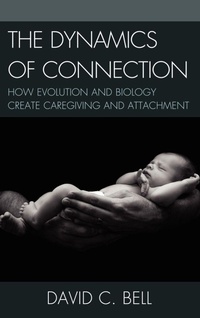
The Dynamics of Connection
How Evolution and Biology Create Caregiving and Attachment
Published on 30. March 2010
Book
Hardback
286 pages
978-0-7391-4352-0 (ISBN)
Description
The Dynamics of Connection: How Evolution and Biology Create Caregiving and Attachment describes the logic of giving, love, trust, and nurturance. Bowlby's theory of attachment provides an excellent starting point for an explanation of nurturance, but there are some limitations in this theory, especially its tendency to minimize the caregiving side of the relationship. The book builds on and extends Bowlby's theory by examining the evolutionary evidence for both attachment and caregiving, the origins of which can be seen in the earliest mammals. It describes neurobiological research that has identified the brain circuits that underlie caregiving and attachment. The book then describes a theory of relationships based on these neurobiological circuits and the resulting human desire to give and receive emotional contact, warmth, and support. The theory details the emotional logic of this relationship process. The proactive connection process (caregiving), characteristic of parents, involves a growing capacity for both empathy and responsibility. In the receptive process (attachment), trust grows from the experience of being cared for and nurtured. These processes coexist alongside other motivations with which they interact.
The Dynamics of Connection introduces a view of the dyadic social psychology of connection that underlies both parent-child and close adult relationships. It provides a description and explanation of parental and adult nurturance. It gives a long-needed account of the origins of social norms of parenting. While building on the foundation of attachment theory, David Bell brings together new insights from both evolutionary theory and neurobiology to deepen our understanding of caregiving and attachment.
The Dynamics of Connection introduces a view of the dyadic social psychology of connection that underlies both parent-child and close adult relationships. It provides a description and explanation of parental and adult nurturance. It gives a long-needed account of the origins of social norms of parenting. While building on the foundation of attachment theory, David Bell brings together new insights from both evolutionary theory and neurobiology to deepen our understanding of caregiving and attachment.
Reviews / Votes
This is a wonderful book that begins with the riddle of nurturance and Bowlby's famous account of attachment and care-giving, but it is what the author does in the next seven chapters that is even more remarkable. He traces the evolution of care-giving from reptiles to mammals to humans, and then he explores the neurological underpinnings of care-giving and attachment, offers a theory of care-giving and attachment, develops a model of relationship formation, and finally, outlines the nature of familial attachment In this book, Bell provides a model for exploring the evolution of biological propensities underlying fundamental social processes. This is not naive sociobiology or even evolutionary psychology; it is what I term evolutionary sociology at its very best because it does not reduce sociology to biology but shows how analysis of biology and evolution can make sociology a more robust and interesting discipline. This book, I hope, represents a harbinger of good things to come as sociology ends its century-long boycott of biology and, in so doing, becomes a more mature explanatory science. -- Jonathan H. Turner, Distinguished Professor of Sociology, University of California, Riverside Bell provides an unusually rich, conceptually deep, multidisciplinary perspective on attachment and caregiving. His analysis is strikingly novel in many respects yet firmly rooted in the extensive literature on these topics. Bell's query begins with his personal experiences, as a husband, parent, and initially alien yet very close observer of Japanese family relationships. Trained as a sociologist, he nevertheless focuses on personal feelings, especially the feeling of caring, and pursues 'love' from the level of sociology and culture to the level of neuroscience and evolutionary biology. The book is extremely engaging, although intellectually demanding, and it is beautifully written throughout. It offers a great deal to think about if you are interested in the biology, psychology, or anthropology of human emotions and relationships. -- Phillip R. Shaver, UC Davis, co-editor of the Handbook of Attachment This ambitious merger of sociology, biology, and psychology finds that the human experience of "attachment" is neither deterministically evolutionary nor altogether socially constructed, but rather a function of varieties of nurturance in dyadic parent-to-child and child-to-parent interactions....Recommended. * Choice Reviews *More details
Language
English
Place of publication
United States
Publishing group
Bloomsbury Publishing Plc
Target group
Professional and scholarly
Dimensions
Height: 235 mm
Width: 157 mm
Thickness: 23 mm
Weight
653 gr
ISBN-13
978-0-7391-4352-0 (9780739143520)
Copyright in bibliographic data and cover images is held by Nielsen Book Services Limited or by the publishers or by their respective licensors: all rights reserved.
Schweitzer Classification
Other editions
Additional editions
E-Book
07/2012
1st Edition
Lexington Books
€111.99
Available for download
E-Book
07/2012
1st Edition
Lexington Books
€111.99
Available for download
Person
David C. Bell is professor of sociology at Indiana University-Purdue University Indianapolis.
Content
Chapter 1 Preface
Chapter 2 Chapter 1. The Riddle of Nurturance
Chapter 3 Chapter 2. Bowlby's Account of Attachment and Caregiving
Chapter 4 Chapter 3. The Evolution of Caregiving and Attachment
Chapter 5 Chapter 4. The Neurobiology of Caregiving and Attachment
Chapter 6 Chapter 5. Caregiving
Chapter 7 Chapter 6. Attachment
Chapter 8 Chapter 7. Interconnections
Chapter 9 Chapter 8. A Connection Theory of Adult Relationship Formation
Chapter 10 Chapter 9. Reconsidering Families
Chapter 2 Chapter 1. The Riddle of Nurturance
Chapter 3 Chapter 2. Bowlby's Account of Attachment and Caregiving
Chapter 4 Chapter 3. The Evolution of Caregiving and Attachment
Chapter 5 Chapter 4. The Neurobiology of Caregiving and Attachment
Chapter 6 Chapter 5. Caregiving
Chapter 7 Chapter 6. Attachment
Chapter 8 Chapter 7. Interconnections
Chapter 9 Chapter 8. A Connection Theory of Adult Relationship Formation
Chapter 10 Chapter 9. Reconsidering Families