


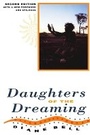
Daughters of the Dreaming
Published on 1. January 1984
Book
Paperback/Softback
297 pages
978-0-86861-472-4 (ISBN)
Description
"Daughters of the Dreaming" is not only a work of ethnographic importance. It also explores the nature of the changes in gender relations in Aboriginal society. Diane Bell was accepted as an adult woman who might be given ritual instruction, who participated in their ceremonies, and visited their sacred sites. But she was faced with an enigma: here was a group of Aboriginal women proud and knowledgeable in the ways of the "jukurrpa" (Dreaming Law) who were regarded by anthropologists as second class citizens, as the pawns in the games of the male polygynous gerontocracy, the exploited and excluded, the substance of symbols but never the makers of their own social reality. Who was fooling whom? Was it the orientation of the fieldworker, the bias of the discipline of anthropology, an imposition of middle-class notions of male/female relations onto Aboriginal society? This study of Aboriginal women's lives from a feminist perspective is been long overdue.
More details
Language
English
Place of publication
Sydney
Australia
Target group
College/higher education
Professional and scholarly
Illustrations
illustrations
Dimensions
Height: 230 mm
Width: 150 mm
ISBN-13
978-0-86861-472-4 (9780868614724)
Copyright in bibliographic data is held by Nielsen Book Services Limited or its licensors: all rights reserved.
Schweitzer Classification
Other editions
New editions
Diane Bell
Daughters of the Dreaming
Book
08/1993
University of Minnesota Press
€48.49
Article not available at the moment
Content
Part 1 Into the field. Part 2 Change and continuity: Reclaiming the past; Fragments of the frontier; The present - Warrabri; The Jukurrpa; Bosses not prisoners. Part 3 The sustaining ideals - land, love and well-being: The Kaytej Jilimi and "Ring Place"; Yawulyu and land; Health; Love. Part 4 We follow one law: "Sometimes we dance together"; Making young men. Part 5 The problem of women.