

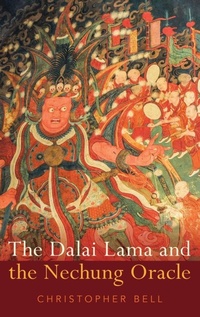
The Dalai Lama and the Nechung Oracle
Published on 5. October 2021
Book
Hardback
328 pages
978-0-19-753335-2 (ISBN)
Description
Tibetan Buddhism and the Dalai Lama enjoy global popularity and relevance, yet the longstanding practice of oracles within the tradition is still little known and understood. The Nechung Oracle, for example, is believed to become possessed by an important god named Pehar, who speaks through the human medium to confer with the Dalai Lama on matters of state. The Dalai Lama and the Nechung Oracle is the first monograph to explore the mythologies and rituals of this god, the Buddhist monastery that houses him, and his close friendship with incarnations of the Dalai Lama over the centuries.
In the seventeenth century, during the reign of the Fifth Dalai Lama, the protector deity Pehar and his oracle at Nechung Monastery were state-sanctioned by the nascent Tibetan government, becoming the head of an expansive pantheon of worldly deities assigned to protect the newly unified country. The governments of later Dalai Lamas expanded the deity's influence, as well as their own, by establishing Pehar at monasteries and temples around Lhasa and across Tibet. Pehar's cult at Nechung Monastery came to embody the Dalai Lama's administrative control in a mutual relationship of protection and prestige, the effects of which continue to reverberate within Tibet and among the Tibetan exile community today. The friendship between these two immortals has spanned nearly five hundred years across the Tibetan plateau and beyond.
In the seventeenth century, during the reign of the Fifth Dalai Lama, the protector deity Pehar and his oracle at Nechung Monastery were state-sanctioned by the nascent Tibetan government, becoming the head of an expansive pantheon of worldly deities assigned to protect the newly unified country. The governments of later Dalai Lamas expanded the deity's influence, as well as their own, by establishing Pehar at monasteries and temples around Lhasa and across Tibet. Pehar's cult at Nechung Monastery came to embody the Dalai Lama's administrative control in a mutual relationship of protection and prestige, the effects of which continue to reverberate within Tibet and among the Tibetan exile community today. The friendship between these two immortals has spanned nearly five hundred years across the Tibetan plateau and beyond.
Reviews / Votes
This is an important and expertly researched account of the relationship between the Tibetan protector deity Pehar and the lineage of the Dalai Lamas, and the rituals and traditions surrounding Pehar's psychophysical manifestation in the Nechung Oracle. * S. Wickhamsmith, CHOICE * Impressive overview * Patrick James Dunagan, Rain Taxi Review of Books * This is an accomplished ... work of scholarship, that takes us deep into the complexities of an arcane aspect of Tibetan Buddhism, which yet retains a significant role in Tibetan national identity. * Alexander Studholme, The Mirror (International Dzogchen Community Magazine) *More details
Language
English
Place of publication
New York
United States
Target group
College/higher education
Illustrations
18
Dimensions
Height: 240 mm
Width: 161 mm
Thickness: 22 mm
Weight
658 gr
ISBN-13
978-0-19-753335-2 (9780197533352)
Copyright in bibliographic data and cover images is held by Nielsen Book Services Limited or by the publishers or by their respective licensors: all rights reserved.
Schweitzer Classification
Other editions
Additional editions
Christopher Bell
The Dalai Lama and the Nechung Oracle
E-Book
03/2021
OUP eBook
€62.99
Available for download
Christopher Bell
The Dalai Lama and the Nechung Oracle
E-Book
03/2021
OUP eBook
€62.99
Available for download
Person
Christopher Bell is Associate Professor of Religious Studies at Stetson University in Florida. His research focuses on Tibetan ritual and deity cults, as well as Asian models of divinity.
Content
Acknowledgement Note on Tibetan Transcription Introduction I. Pehar and the Five King Spirits II. The Fifth Dalai Lama's God III. The Central Rituals IV. The Liturgical Calendar V. Nechung Monastery VI. Institutional Networks VII. The Nechung Oracle Conclusion Bibliography Index