

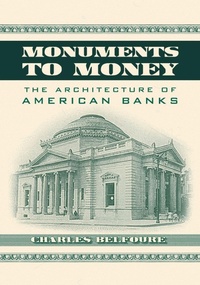
Monuments to Money
The Architecture of American Banks
Published on 13. December 2011
Book
Paperback/Softback
358 pages
978-0-7864-6413-5 (ISBN)
Description
To understand the evolution of bank design, it is also necessary to grasp the fundamentals of America's banking and financial history, which go hand-in-hand with the creation of bank architecture. While the worldwide evolution of architectural styles played a major factor in the way banks look, developments in the financial history of the nation--depressions, panics, government monetary and banking policy--also played a critical role.
With more than 200 photographs and illustrations, this work studies the evolution of American bank architecture from 1781 (when America's first bank was founded) to new banks of the present day. It explores how and why the classically inspired structures built in late 18th century America, embodying strength and trust, evolved into the essentially anonymous bank buildings of today.
With more than 200 photographs and illustrations, this work studies the evolution of American bank architecture from 1781 (when America's first bank was founded) to new banks of the present day. It explores how and why the classically inspired structures built in late 18th century America, embodying strength and trust, evolved into the essentially anonymous bank buildings of today.
Reviews / Votes
"banks were built impressively...to convince customers their investments were solid and their savings secure...provides many photos and line drawings"-C&RL News.More details
Language
English
Place of publication
Jefferson, NC
United States
Target group
College/higher education
Professional and scholarly
Interest Age: From 18 years
Product notice
Paperback (trade)
Illustrations
222 photos, notes, bibliography, index
Dimensions
Height: 254 mm
Width: 178 mm
Thickness: 19 mm
Weight
677 gr
ISBN-13
978-0-7864-6413-5 (9780786464135)
Copyright in bibliographic data and cover images is held by Nielsen Book Services Limited or by the publishers or by their respective licensors: all rights reserved.
Schweitzer Classification
Person
Architect and writer Charles Belfoure lives in Westminster, Maryland. He is the coauthor of The Baltimore Rowhouse.
Content
Table of Contents
Acknowledgements
Preface
Introduction
1. The Early Republic: Neo-Classicism and the Federal Style
2. The Jacksonian Age: The Greek Revival
3. The Gilded Age: Victorian Eclecticism
4. The Turn of the Century: The Classical Revival
5. The Early Moderns: Sullivan and the Prairie School
6. The Great Depression: Modern Classicism
7. Postwar Prosperity: Modernism
8. The Twenty-First Century: Financial Department Stores
9. New Uses for Banks
Notes
Selected Bibliography
Index
Acknowledgements
Preface
Introduction
1. The Early Republic: Neo-Classicism and the Federal Style
2. The Jacksonian Age: The Greek Revival
3. The Gilded Age: Victorian Eclecticism
4. The Turn of the Century: The Classical Revival
5. The Early Moderns: Sullivan and the Prairie School
6. The Great Depression: Modern Classicism
7. Postwar Prosperity: Modernism
8. The Twenty-First Century: Financial Department Stores
9. New Uses for Banks
Notes
Selected Bibliography
Index