

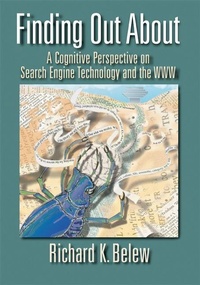
Finding Out About
A Cognitive Perspective on Search Engine Technology and the WWW
Published on 14. July 2008
Book
Paperback/Softback
384 pages
978-0-521-73446-2 (ISBN)
Description
Finding Out About explains how to build useful tools for searching collections of text and other media. In the process it takes a close look at the properties of textual documents that do not become clear until very large collections of them are brought together and shows that the constructions of effective search engines requires knowledge of the statistical and mathematical properties of linguistic phenomena, as well as an appreciation for the cognitive foundation we bring to the task as language users. The unique approach of this book is its even handling of the phenomena of both numbers and words, giving it a wide appeal. The textbook works for undergraduate and graduate classes on information retrieval, library science, and computational linguistics. More exercises are available to instructors. A supporting Web site includes recent additions to the book, as well as links to sites of new topics and methods.
Reviews / Votes
'One of the wonderful things about this textbook is that it considers information retrieval in the context of the Web ... It is only in the last ten years that a new technology- the World Wide Web - has started to have an impact on people's information-seeking activities. It is not easy to introduce current technology meaningfully and successfully into scientific discussions about IR, but Rik Belew has done just that. Students will come to this book with quite a sophisticated knowledge of the Web and will not be disappointed. From the point of view of a teacher introducing the Web as a vehicle for experimentation, it is ideal.' Keith van Rijsbergen, from the Foreword 'A comprehensive resource for teaching a programming-based information retrieval class. The text provides an integrated introduction to many topics in information retrieval with a strong emphasis on mathematical and machine learning models, as well as giving a clear account of implementation details for the programming assignments.' Information Retrieval '... readable, understandable, and inspiring. It is strongly recommended.' E. Kostolansky, Zentralblatt fuer Mathematik 'This is a fascinating work - the author describes it as a 'textbook' but it is more than that ... refreshingly, Belew's book takes a broader view ... than has tended to be the case in most earlier books ... the overall structure is particularly well thought out ... this is a very welcome addition to the book literature ... notable for its concise and very up-to-date summarising of theoretical knowledge, its stimulating cross-disciplinarity, and its challenging and creative use of IT to support is readership. Many students will find it inspirational.' Michael Heine, Journal of DocumentationMore details
Language
English
Place of publication
Cambridge
United Kingdom
Target group
College/higher education
Professional and scholarly
Product notice
Paperback (trade)
Illustrations
Worked examples or Exercises; 20 Tables, unspecified; 5 Plates, color; 10 Halftones, unspecified
Dimensions
Height: 235 mm
Width: 191 mm
Thickness: 21 mm
Weight
719 gr
ISBN-13
978-0-521-73446-2 (9780521734462)
Copyright in bibliographic data and cover images is held by Nielsen Book Services Limited or by the publishers or by their respective licensors: all rights reserved.
Schweitzer Classification
Other editions
Additional editions
Book
02/2001
Cambridge University Press
€60.76
Article exhausted; check for reprint
Previous edition
Book
02/2001
Cambridge University Press
€60.76
Article exhausted; check for reprint
Person
Richard K. Belew is a professor in the Computer Science and Engineering departments at The University of California, San Diego. He is an associate editor of the journal Evolutionary Computation and co-editor (with Melanie Mitchell) of Adaptive Individuals in Populations (1996).
Content
1. Overview; 2. Extracting lexical features; 3. Weighting and matching against indices; 4. Assessing the retrieval; 5. Mathematical foundations; 6. Inference beyond the index; 7. Adaptive information retrieval; 8. Conclusions and future directions.