

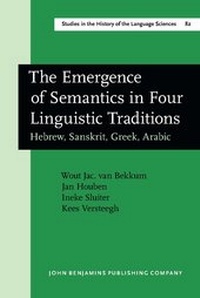
The Emergence of Semantics in Four Linguistic Traditions
Hebrew, Sanskrit, Greek, Arabic
Published on 3. April 1997
Book
Hardback
322 pages
978-90-272-4568-7 (ISBN)
Description
The aim of this study is a comparative analysis of the role of semantics in the linguistic theory of four grammatical traditions, Sanskrit, Hebrew, Greek, Arabic. If one compares the organization of linguistic theory in various grammatical traditions, it soon turns out that there are marked differences in the way they define the place of 'semantics' within the theory. In some traditions, semantics is formally excluded from linguistic theory, and linguists do not express any opinion as to the relationship between syntactic and semantic analysis. In other traditions, the whole basis of linguistic theory is semantically orientated, and syntactic features are always analysed as correlates of a semantic structure. However, even in those traditions, in which semantics falls explicitly or implicitly outside the scope of linguistics, there may be factors forcing linguists to occupy themselves with the semantic dimension of language. One important factor seems to be the presence of a corpus of revealed/sacred texts: the necessity to formulate hermeneutic rules for the interpretation of this corpus brings semantics in through the back door.
More details
Series
Language
English
Place of publication
Amsterdam
Netherlands
Target group
College/higher education
Professional and scholarly
Dimensions
Height: 245 mm
Width: 164 mm
Weight
540 gr
ISBN-13
978-90-272-4568-7 (9789027245687)
Copyright in bibliographic data and cover images is held by Nielsen Book Services Limited or by the publishers or by their respective licensors: all rights reserved.
Schweitzer Classification
Other editions
Additional editions
Wout J. van Bekkum | Jan Houben | Ineke Sluiter
The Emergence of Semantics in Four Linguistic Traditions
Hebrew, Sanskrit, Greek, Arabic
E-Book
04/1997
1st Edition
John Benjamins Publishing Company
€149.99
Available for download
Persons
Content
1. Preface; 2. Part I The Hebrew tradition; 3. 1. Introduction; 4. 2. Terminology; 5. 3. Intra-Biblical tradition; 6. 4. Rabbinic exegetical tradition; 7. 5. Language and exegesis in the medieval Jewish tradition; 8. 5.1 Saadiah Gaon; 9. 5.2 Translation technique; 10. 5.3 The way towards pesat; 11. 5.4 Meaning in Hebrew grammar and lexicography; 12. 6. The logical and philosophical tradition of medieval Judaism; 13. 6.1 Moses Maimonides; 14. 6.2 The influence of Maimonides; 15. 7. Conclusion; 16. 8. Suggestions for further reading; 17. 9. Bibliographical references; 18. Part II The Sanskrit tradition; 19. 1. Introduction; 20. 2. Terminology; 21. 3. Awareness of language and meaning in early Vedic texts and ancillary disciplines; 22. 3.1 The Vedic hymns; 23. 3.2 The Brahmanas and ancillary disciplines; 24. 4. Nirukta: "etymology" or "explanation of word meaning through derivation"; 25. 5. The exegetic guidelines of early Mimamsa; 26. 6. Grammar and semantics in the early Paninian tradition; 27. 6.1 The role of meanings and semantics in Panini's grammar; 28. 6.2 Early commentators on Panini's Astadhyayi: Katyayana and Patanjali; 29. 7. Logic, ontology and semantics in Nyaya and Vaisesika; 30. 7.1 The Vaisesika-system; 31. 7.2 The Nyaya-system; 32. 8. Challenging the Brahminical tradition: Buddhists and Jainas; 33. 8.1 The Jainas; 34. 8.2 The Buddhists; 35. 9. Bhartrhari's discussion of linguistic and semantic theories: major issues and parameters; 36. 9.1 The first book of the Vakyapadiya: Introductory matter and the relation between sound, signifier and meaning; 37. 9.2 The second book of the Vakyapadiya: On the primary unit in language; 38. 9.3 The third book of the Vakyapadiya: Philosophical and semantic investigations of grammatical categories pertaining to the words in the sentence; 39. 10. Developments after the Vakyapadiya: apoha "exclusion", poetics, theories of sabda-bodha "understanding from language"; 40. 11. Conclusion; 41. 12. Suggestions for further reading; 42. 13. Bibliographical references; 43. Part III The Greek tradition; 44. 1. Introduction; 45. 2. Terminology; 46. 3. Folk linguistics, etymology, magic: The meaning of names; 47. 4. Pre-Alexandrian exegesis (6th-4th centuries BCE); 48. 5. The intellectuals' debate in the 6th and 5th centuries BCE of language, truth, knowledge and reality; 49. 6. Plato: The limits of language; 50. 7. Aristotle: The function of language; 51. 8. The Hellenistic period: Philosophy and philology; 52. 9. Apollonius Dyscolus: The role of semantics in syntactic theory; 53. 10. Augustine: Semantics and theology; 54. 11. Semantics and translation; 55. 12. Conclusion; 56. 13. Suggestions for further reading; 57. 14. Bibliographical references; 58. Part IV The Arabic tradition; 59. 1. Introduction; 60. 2. From speaker to text: The exegetical tradition; 61. 3. From text to language: Sibawayhi; 62. 4. The role of semantics in Arabic linguistic theory; 63. 5. The relationship between logic and grammar; 64. 6. The relationship between rhetoric and grammar; 65. 7. Towards a theory of signification; 66. 8. Conclusion; 67. 9. Suggestions for further reading; 68. 10. Bibliographical references; 69. Meaning in four linguistic traditions: a comparison; 70. 1. Introduction; 71. 2. From exegesis to semantics; 72. 3. The role of canonical texts; 73. 4. Beginnings of linguistic thought within canonical texts: etymology; 74. 5. Exegesis; 75. 6. Beginnings of semantic theory: influence from other disciplines-distinction of sound and meaning; 76. 7. The locus of meaning; 77. 8. Incongruity between form and meaning; 78. 9. The nature and origin of language; 79. 10. Contacts between languages: translations; 80. 11. An area of disagreement: The status of exegesis; 81. Chronological Table; 82. Index of names; 83. Index of subjects