

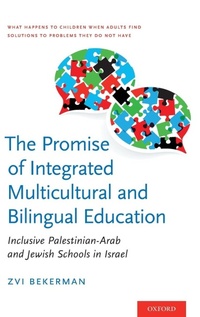
The Promise of Integrated Multicultural and Bilingual Education
Inclusive Palestinian-Arab and Jewish Schools in Israel
Published on 4. February 2016
Book
Hardback
368 pages
978-0-19-933651-7 (ISBN)
Description
The Promise of Integrated and Multicultural Bilingual Education presents the results of a long-term ethnographic study of the integrated bilingual Palestinian-Jewish schools in Israel that offer a new educational option to two groups of Israelis-Palestinians and Jews-who have been in conflict for the last one hundred years. Their goal is to create egalitarian bilingual multicultural environments to facilitate the growth of youth who can acknowledge and
respect "others" while maintaining loyalty to their respective cultural traditions. In this book, Bekerman reveals the complex school practices implemented while negotiating identity and culture in contexts of enduring conflict. Data gathered from interviews with teachers, students, parents, and state officials
are presented and analyzed to explore the potential and limitations of peace education given the cultural resources, ethnic-religious affiliations, political beliefs, and historical narratives of the various interactants. The book concludes with critique of Western positivist paradigmatic perspectives that currently guide peace education, maintaining that one of the primary weaknesses of current bilingual and multicultural approaches to peace education is their failure to account for the
primacy of the political framework of the nation state and the psychologized educational perspectives that guide their educational work. Change, it is argued, will only occur after these perspectives are abandoned, which entails critically reviewing present understandings of the individual, of identity
and culture, and of the learning process.
respect "others" while maintaining loyalty to their respective cultural traditions. In this book, Bekerman reveals the complex school practices implemented while negotiating identity and culture in contexts of enduring conflict. Data gathered from interviews with teachers, students, parents, and state officials
are presented and analyzed to explore the potential and limitations of peace education given the cultural resources, ethnic-religious affiliations, political beliefs, and historical narratives of the various interactants. The book concludes with critique of Western positivist paradigmatic perspectives that currently guide peace education, maintaining that one of the primary weaknesses of current bilingual and multicultural approaches to peace education is their failure to account for the
primacy of the political framework of the nation state and the psychologized educational perspectives that guide their educational work. Change, it is argued, will only occur after these perspectives are abandoned, which entails critically reviewing present understandings of the individual, of identity
and culture, and of the learning process.
More details
Other editions
Additional editions
Zvi Bekerman
The Promise of Integrated Multicultural and Bilingual Education
Inclusive Palestinian-Arab and Jewish Schools in Israel
E-Book
01/2016
1st Edition
OUP eBook
€63.49
Available for download
Zvi Bekerman
The Promise of Integrated Multicultural and Bilingual Education
Inclusive Palestinian-Arab and Jewish Schools in Israel
E-Book
01/2016
1st Edition
OUP eBook
€63.49
Available for download
Person
Zvi Bekerman teaches anthropology of education at the School of Education and The Melton Center, Hebrew University of Jerusalem. His main interests are in the study of cultural, ethnic, and national identity, including identity processes and negotiation during intercultural encounters and in formal/informal learning contexts. He is particularly interested in how concepts such as culture and identity intersect with issues of social justice, intercultural and peace
education, and citizenship education.
education, and citizenship education.
Content
Introduction; Part 1 ; Chapter 1: Positioning the Author; Chapter 2: Theoretical Perspectives; Chapter 3: Methodology: From Theory to Implementation; Chapter 4: Schools in Their Contexts; Part 2 ; Chapter 5: The Parents; Chapter 6: Teachers at Their Work; Chapter 7: The Children; Part 3 ; Chapter 8: School Routines: Culture, Religion, and Politics in the Classroom; Chapter 9: Ceremonial Events; Chapter 10: Conflicting National Narratives; Part 4 ; Chapter 11: The Graduates; Chapter 12: Conclusions