

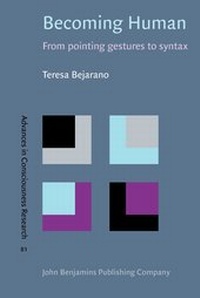
Becoming Human
From pointing gestures to syntax
Published on 6. July 2011
Book
Hardback
402 pages
978-90-272-5217-3 (ISBN)
Description
What do the pointing gesture, the imitation of new complex motor patterns, the evocation of absent objects and the grasping of others' false beliefs all have in common? Apart from being (one way or other) involved in the language, they all would share a demanding requirement - a second mental centre within the subject. This redefinition of the simulationism is extended in the present book in two directions. Firstly, mirror-neurons and, likewise, animal abilities connected with the visual field of their fellows, although they certainly constitute important landmarks, would not require this second mental centre. Secondly, others' beliefs would have given rise not only to predicative communicative function but also to pre-grammatical syntax. The inquiry about the evolutionary-historic origin of language focuses on the cognitive requirements on it as a faculty (but not to the indirect causes such as environmental changes or greater co-operation), pays attention to children, and covers other human peculiarities as well, e.g., symbolic play, protodeclaratives, self-conscious emotions, and interactional or four-hand tasks.
Reviews / Votes
Teresa Bejarano [...] is thoroughly familiar with the literature on language, developmental psychology, and primate behavior. She argues that the special qualities of the human mind depend on the emergence of what she calls a second center that confers the ability to simulate the minds of others [...]. I think second center, at least in Bejarano's treatment, offers more theoretical mileage than do these other concepts-working memory, imitation, recursion [...]. I can thoroughly recommend this stimulating book. -- Michael C. Corballis, University of Auckland, in PsycCRITIQUES, March 7, 2012. Vol. 57, Release 10, Article 3More details
Series
Language
English
Place of publication
Amsterdam
Netherlands
Target group
Professional and scholarly
Illustrations
+ index
Dimensions
Height: 245 mm
Width: 164 mm
Weight
910 gr
ISBN-13
978-90-272-5217-3 (9789027252173)
Copyright in bibliographic data and cover images is held by Nielsen Book Services Limited or by the publishers or by their respective licensors: all rights reserved.
Schweitzer Classification
Other editions
Additional editions
E-Book
07/2011
1st Edition
John Benjamins Publishing Company
€123.99
Available for download
Person
Content
1. Introduction; 2. Section one. Evolutionary precursors; 3. Chapter 1. Monkeys' mirror neurons; 4. Chapter 2. Chimpanzees and the visual field of the conspecific; 5. Section two. The basic human ability; 6. Chapter 3. The three modes of processing the eyes of others; 7. Chapter 4. Pointing gestures; 8. Chapter 5. Four-hand co-operative actions and children's interpersonal co-ordination games; 9. Section three. Specifying some necessary requisites of language; 10. Chapter 6. Saussurean parity and the perception of a radically not-own self; 11. Chapter 7. About evocation; 12. Chapter 8. Symbolic play: Developments in the simulatory centre; 13. Chapter 9. From symbolic play to linguistic symbol; 14. Section four. The origin of predication and syntax; 15. Chapter 10. From the general exposition to the crucial requisite achieved by the protodeclarative; 16. Chapter 11. Toward the original perception of false beliefs of others: The importance of the learned sign; 17. Chapter 12. Between motor learning and the perception of beliefs of others: The crucial role of the protodeclarative; 18. Section five. Pregrammatical, theme-rheme syntax: Revisiting Frege and Vygotsky; 19. Chapter 13. From beliefs of others to communicative predication; 20. Chapter 14. Revisiting Frege: How can a predication be at one and the same time true and not redundant?; 21. Chapter 15. Communicative functions, Vygotskian 'pure predicate' and conceptual semantics: Various questions about predication; 22. Chapter 16. Connecting with the concepts of theme (or topic) and rheme (or comment); 23. Section six. From original to present-day predication: Links and grammatical syntax; 24. Chapter 17. Meaning and the different types of link; 25. Chapter 18. Expressive speech and syntactic links: A hypothesis on the historic origins of those links, and on some other questions, along the way; 26. Chapter 19. Historical grammaticalisation: The answers are lacking, but the questions are good; 27. Section seven. Syntax beyond predication; 28. Chapter 20. Interrogative communication; 29. Chapter 21. Toward complex syntax: The crucial role of reported speech; 30. Preliminary conclusion and the main thesis recapitulated; 31. References; 32. Glossary; 33. Author index; 34. Subject index