

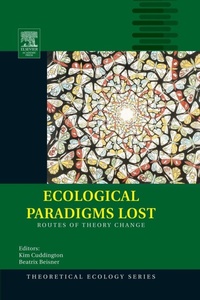
Ecological Paradigms Lost: Volume 2
Routes of Theory Change
Published on 23. August 2005
Book
Paperback/Softback
464 pages
978-0-12-088459-9 (ISBN)
Description
This edited volume in the Theoretical Ecology series addresses the historical development and evolution of theoretical ideas in the field of ecology. Not only does Ecological Paradigms Lost recount the history of the discipline by practitioners of the science of ecology, it includes commentary on these historical reflections by philosophers of science. Even though the theories discussed are, in many cases, are at the forefront of research, the language and approach make this material accessible to non-theoreticians. The book is structured in 5 major sections including population ecology, epidemiology, community ecology, evolutionary biology and ecosystem ecology. In each section a chapter by an eminent, experienced ecologist is complemented by analysis from a newer, cutting-edge researcher.
Reviews / Votes
"Finally, here is a book taking ecology seriously enough also to investigate it from a philosophy of science point of view, and in particular taking a Kuhnian entrance point as also indicated by the title...an exciting book and an interesting idea to view our science as Kuhn would have done...highly recommended." --Soren Nors Nielsen, Danmarks Farmaceutiske Universitet"Each section of Ecological Paradigms Lost certainly has something to offer the specialist." --Joseph Craine, Unviersity of Minnesota, Department of Ecology, Evolution, and Behavior, in BIOSCIENCE
The editors of this volume commissioned papers by eminent ecologists, young and old, on theory development and cahnge in five subfields- population, epidemiological, community, evolutionary, and ecosystem ecology- and papers from philosophers of science commenting on the scientists' conclusions...a better perspective on ecology's past and, possibly, its future." --Thomas R. Dunlap, Texas A&M University, Department of History, in ECOLOGY
More details
Series
Language
English
Place of publication
San Diego
United States
Publishing group
Elsevier Science Publishing Co Inc
Target group
Professional and scholarly
practicing ecologists, to philosophers of science, and to anyone interested in the history of ecology
Product notice
Paperback (trade)
Illustrations
Illustrated
Dimensions
Height: 234 mm
Width: 156 mm
Thickness: 24 mm
Weight
641 gr
ISBN-13
978-0-12-088459-9 (9780120884599)
Copyright in bibliographic data and cover images is held by Nielsen Book Services Limited or by the publishers or by their respective licensors: all rights reserved.
Schweitzer Classification
Other editions
Additional editions
E-Book
08/2005
Academic Press
€86.95
Available for download
Persons
Content
1. Why a History of Ecology: An Introduction
Beatrix E. Beisner and Kim Cuddington
Part I
POPULATION ECOLOGY
2. Unstructured Models in Ecology: Past, Present and Future
3.Unstructured population models: Do population-level assumptions yield general theory?
4. The "Structure? of Population Ecology: Philosophical Reflections on Unstructured and Structured Models
Part II
EPIDEMIOLOGICAL ECOLOGY
5. The Law of Mass Action in Epidemiology: A Historical Perspective
6. Extensions to Mass Action Mixing
7. Mass Action and System Analysis of Infection Transmission
Part III
COMMUNITY ECOLOGY
8. Community Diversity and Stability: Changing Perspectives and Changing Definitions
9. Perspectives on Diversity, Structure and Stability
10. Diversity and Stability: Theories, Models and Data
Part IV
EVOLUTIONARY ECOLOGY
11. On the Integration of Community Ecology and Evolutionary Biology: Historical Perspectives and Current Prospects
12. Modeling the ecological context of evolutionary change: deja vu or something new?
13. The Elusive Synthesis
Part V
ECOSYSTEM ECOLOGY
14. The Loss of Narrative
15. Ecological Management: Control, Uncertainty and Understanding
16. Is Ecosystem Management a Postmodern Science?
Kevin de Laplante
Part VI
CONCLUSION
17. Kuhnian Paradigms Lost: Embracing the pluralism of ecological theory
Beatrix E. Beisner and Kim Cuddington
Part I
POPULATION ECOLOGY
2. Unstructured Models in Ecology: Past, Present and Future
3.Unstructured population models: Do population-level assumptions yield general theory?
4. The "Structure? of Population Ecology: Philosophical Reflections on Unstructured and Structured Models
Part II
EPIDEMIOLOGICAL ECOLOGY
5. The Law of Mass Action in Epidemiology: A Historical Perspective
6. Extensions to Mass Action Mixing
7. Mass Action and System Analysis of Infection Transmission
Part III
COMMUNITY ECOLOGY
8. Community Diversity and Stability: Changing Perspectives and Changing Definitions
9. Perspectives on Diversity, Structure and Stability
10. Diversity and Stability: Theories, Models and Data
Part IV
EVOLUTIONARY ECOLOGY
11. On the Integration of Community Ecology and Evolutionary Biology: Historical Perspectives and Current Prospects
12. Modeling the ecological context of evolutionary change: deja vu or something new?
13. The Elusive Synthesis
Part V
ECOSYSTEM ECOLOGY
14. The Loss of Narrative
15. Ecological Management: Control, Uncertainty and Understanding
16. Is Ecosystem Management a Postmodern Science?
Kevin de Laplante
Part VI
CONCLUSION
17. Kuhnian Paradigms Lost: Embracing the pluralism of ecological theory