

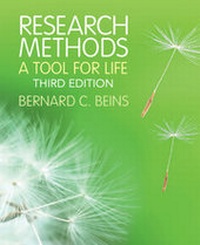
Research Methods
A Tool for Life
3rd Edition
Published on 19. September 2017
Book
Paperback/Softback
474 pages
978-1-108-43623-6 (ISBN)
Description
Research Methods is an introduction to the importance of scientific research in everyday life and uses familiar examples to keep students engaged. The text analyzes controversies in psychology to stimulate student interest while explaining crucial methodological concepts. It presents ethical issues related to research, as well as social and cultural factors that might affect it, and provides a comprehensive introduction to a wide variety of methodologies. Through this book, students will learn how to generate research questions and select appropriate methodology, as well as to write a successful research report.
More details
Edition
3rd Revised edition
Language
English
Place of publication
Cambridge
United Kingdom
Target group
College/higher education
Edition type
Revised edition
Product notice
Paperback (trade)
Illustrations
Worked examples or Exercises
Dimensions
Height: 234 mm
Width: 190 mm
Thickness: 24 mm
Weight
870 gr
ISBN-13
978-1-108-43623-6 (9781108436236)
Copyright in bibliographic data and cover images is held by Nielsen Book Services Limited or by the publishers or by their respective licensors: all rights reserved.
Schweitzer Classification
Other editions
New editions
Book
11/2018
4th Edition
Cambridge University Press
€126.30
Available immediately
Additional editions
E-Book
08/2018
3rd Edition
Cambridge University Press
€75.49
Available for download
Person
Bernard C. Beins is Professor of Psychology at Ithaca College, New York. He has been President-elect of the New England Psychological Association and the Society for the Teaching of Psychology.
Content
1. Psychology, science, and life; 2. Ethics in research; 3. Planning research - generating a question; 4. Practical issues in planning your research; 5. Measurement and sampling; 6. Conducting an experiment - general principles; 7. Experiments with one independent variable; 8. Experiments with multiple independent variables; 9. Expanding on experimental designs: repeated measures and quasi-experiments; 10. Principles of survey research; 11. Correlational research; 12. Studying patterns in the natural world - observational approaches; 13. Research in depth - longitudinal and single-case studies; 14. People are different - considering cultural and individual differences in research; Appendix A. Writing a research report; Appendix B. Statistics review; Appendix C. Statistical tables.