

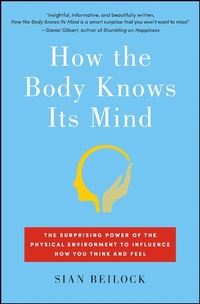
How the Body Knows Its Mind
The Surprising Power of the Physical Environment to Influence How You Think and Feel
Published on 14. March 2017
Book
Paperback/Softback
288 pages
978-1-4516-2669-8 (ISBN)
Description
“Beilock reveals one intriguing secret after another...That Beilock is supercharged with enthusiasm about her topic is evident and infectious” (Booklist, starred review).
The human body is not just a passive device carrying out messages sent by the brain, but rather an integral part of how we think and make decisions. In this groundbreaking book, Sian Beilock, award-winning scientist and author of the highly acclaimed Choke, draws on her own cutting-edge research to turn the conventional understanding of the mind upside down in ways that will revolutionize our lives.
At the heart of How the Body Knows Its Mind is the tantalizing idea that our bodies “hack” our brains. The way we move affects our thoughts, our decisions, and even our preferences for particular products. Called “embodied cognition,” this new science—of which Beilock is a foremost researcher—illuminates the power of the body and its physical surroundings to shape how we think, feel, and behave. For example, pacing around the room can enhance creativity; gesturing during a speech can help ensure you don’t draw a blank; teaching kids through body movement helps them learn better; walking in nature boosts concentration skills; using Botox could lead to less depression; and much more.
“Insightful, informative, and beautifully written” (Daniel Gilbert, author of Stumbling on Happiness), How the Body Knows Its Mind unveils a wealth of fascinating mind-body interconnections and explores how mastering them can make us happier, safer, and more successful.
The human body is not just a passive device carrying out messages sent by the brain, but rather an integral part of how we think and make decisions. In this groundbreaking book, Sian Beilock, award-winning scientist and author of the highly acclaimed Choke, draws on her own cutting-edge research to turn the conventional understanding of the mind upside down in ways that will revolutionize our lives.
At the heart of How the Body Knows Its Mind is the tantalizing idea that our bodies “hack” our brains. The way we move affects our thoughts, our decisions, and even our preferences for particular products. Called “embodied cognition,” this new science—of which Beilock is a foremost researcher—illuminates the power of the body and its physical surroundings to shape how we think, feel, and behave. For example, pacing around the room can enhance creativity; gesturing during a speech can help ensure you don’t draw a blank; teaching kids through body movement helps them learn better; walking in nature boosts concentration skills; using Botox could lead to less depression; and much more.
“Insightful, informative, and beautifully written” (Daniel Gilbert, author of Stumbling on Happiness), How the Body Knows Its Mind unveils a wealth of fascinating mind-body interconnections and explores how mastering them can make us happier, safer, and more successful.
More details
Language
English
Product notice
Paperback (trade)
Unsewn / adhesive bound
Dimensions
Height: 211 mm
Width: 141 mm
Thickness: 22 mm
Weight
255 gr
ISBN-13
978-1-4516-2669-8 (9781451626698)
Copyright in bibliographic data and cover images is held by Nielsen Book Services Limited or by the publishers or by their respective licensors: all rights reserved.
Schweitzer Classification
Other editions
Additional editions
Sian Beilock
How the Body Knows Its Mind
The Surprising Power of the Physical Environment to Influence How You Think and Feel
E-Book
01/2015
1st Edition
Atria Books
€13.84
Available for download
Person
Sian Beilock, a leading expert on the brain science behind human performance, is a professor in the psychology department at the University of Chicago. She has PhDs in both kinesiology and psychology from Michigan State University, and received an award for Transformative Early Career Contributions from the Association for Psychological Science in 2011.