

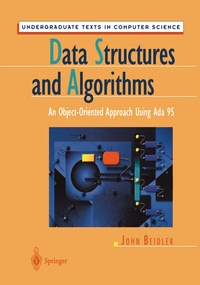
Data Structures and Algorithms
An Object-Oriented Approach Using Ada 95
Published on 4. October 2012
Book
Paperback/Softback
XVI, 364 pages
978-1-4612-7312-7 (ISBN)
Description
This textbook provides an in depth course on data structures in the context of object oriented development. Its main themes are abstraction, implementation, encapsulation, and measurement: that is, that the software process begins with abstraction of data types, which then lead to alternate representations and encapsulation, and finally to resource measurement. A clear object oriented approach, making use of Booch components, will provide readers with a useful library of data structure components and experience in software reuse. Students using this book are expected to have a reasonable understanding of the basic logical structures such as stacks and queues. Throughout, Ada 95 is used and the author takes full advantage of Ada's encapsulation features and the ability to present specifications without implementational details. Ada code is supported by two suites available over the World Wide Web.
More details
Series
Edition
Softcover reprint of the original 1st ed. 1997
Language
English
Place of publication
New York
United States
Target group
Lower undergraduate
Illustrations
XVI, 364 p.
Dimensions
Height: 254 mm
Width: 178 mm
Thickness: 21 mm
Weight
721 gr
ISBN-13
978-1-4612-7312-7 (9781461273127)
DOI
10.1007/978-1-4612-1854-8
Schweitzer Classification
Other editions
Additional editions
E-Book
12/2012
Springer
€53.49
Available for download
Book
10/1996
Springer
€53.49
Shipment within 5-7 days
Content
1 Preliminaries.- 1.1 Object-Oriented Software Development.- 1.2 Problem Analysis.- 1.3 Solution Design.- 1.4 Design to Implementation.- 1.5 Software Maintenance.- 1.6 Data Structures and Algorithms.- 1.7 Ada 95.- 1.8 Simple Static Types.- 1.9 Structured Data Types.- 1.10 Explorations.- 2 Encapsulation.- 2.1 Concept.- 2.2 Packaging Fundamentals.- 2.3 Using Generic Packages.- 2.4 Object-Oriented Support.- 2.5 Using Object-Oriented Packaging.- 2.6 A Taxonomy of Client/Package Visibility.- 2.7 Composability.- 2.8 Child Units.- 2.9 Explorations.- 3 Stacks.- 3.1 Linear Structures.- 3.2 Elementary Stacks.- 3.3 Advanced Features.- 3.4 Iterators.- 3.5 Explorations.- 4 Queues.- 4.1 Elementary Queues.- 4.2 Advanced Features.- 4.3 Iterators.- 4.4 Explorations.- 5 Lists.- 5.1 Recursive Paradigm.- 5.2 Positional Paradigm.- 5.3 Explorations.- 6 Trees.- 6.1 Nonlinear Structures.- 6.2 Binary Trees, Positional Paradigm.- 6.3 Binary Trees, Recursive Paradigm.- 6.4 Tree Traversals.- 6.5 Complete Trees.- 7 Tree Applications.- 7.1 Tree Restructuring.- 7.2 Heaps.- 7.3 Dictionary Trees.- 7.4 Explorations.- 8 Graphs.- 8.1 Graphs and Digraphs.- 8.2 Digraph Specifications.- 8.3 Matrix Representation.- 8.4 Table Representation.- 8.5 Dynamic Representation.- 8.6 Applications.- 8.7 Explorations.- 9 Sets.- 9.1 Specifications.- 9.2 Static Representation.- 9.3 Dynamic Representation.- 9.4 Hashing Representation.- 9.5 Hamming Codes.- 9.6 Bags.- 9.7 Explorations.- 10 Strings.- 10.1 Specifications.- 10.2 Static Representations.- 10.3 Dynamic Representations.- 10.4 String Search Algorithms.- 10.5 Tradeoffs.- 10.6 Explorations.- 11 Sorting.- 11.1O(n2)Sorts.- 11.2 Better Sorts.- 11.3O(nlogn)Sorts.- 11.4 Explorations.- 12 Search/Update.- 12.1 Sequential Search.- 12.2 Bisection Method Search.- 12.3 Block Sequential Search/Update.- 12.4 Address Calculation Search/Update.- 12.5 Hashing.- 12.6 Evaluation.- 12.7 Explorations.- References.